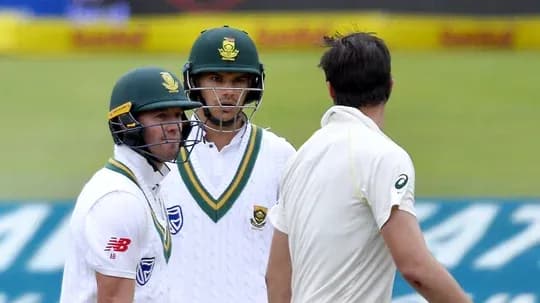
AB de Villiers Reveals Ball Tampering Timeline in 2018 Scandal
AB de Villiers has pushed the timeline of Australia's infamous 2018 ball-tampering scandal back by a full Test, insisting the illegal manipulation of the ball started in Durban, not Port Elizabeth.
The saga has roared back into the spotlight after Usman Khawaja’s autobiography Sabr revisited the events of that ill-tempered series in South Africa. Since then, Khawaja, Chadd Sayers and Cameron Bancroft have all laid out how sandpaper was used on the ball during the second Test in Port Elizabeth, the match before Bancroft was caught on camera with sandpaper at Newlands.
De Villiers, though, believes the rot set in earlier.
“It started in Durban, by the way, not in PE,” he said on his podcast. “And I'm very happy for people to quote me on that. We lost that first Test match in Durban with the ball reversing at a very, very interesting time. Way too early for anyone to reverse a ball at Kingsmead.
“Trust me, I've played a lot of cricket there.”
He was not an armchair observer. De Villiers scored a century against the reversing ball in Port Elizabeth and stood at the crease in Cape Town when Bancroft was confronted by the umpires with the sandpaper. To him, what happened in Durban was no coincidence.
“Whatever they did there, whether it was sandpaper or a nail or I don't care. I honestly do not care,” he said. “The fact of the matter is they were caught and everyone knew.
“The bowlers in particular knew because the ball doesn't just reverse. It's not your first Test match for Australia. So just stand up and say, ‘guys, we were wrong’.”
That version collides head‑on with Bancroft’s own account. In a detailed first-person piece published last week, the opener drew a clear line between the first and second Tests, denying sandpaper was used in Durban, where Mitchell Starc’s reverse swing ripped through South Africa.
“Casting forward to the first Test in Durban, sandpaper was not used,” Bancroft wrote. “There were more traditional methods of maintaining the ball, including saliva. I cannot say with certainty whether mints or lollies were involved. Probably quarter-seam picking, this practice became so normal after my first Test.
“Importantly for the chronology of events, I was not responsible for the ball in that Test. However, what happened in the second Test in Port Elizabeth was different. It was a significant escalation. And it was where I became directly involved.”
Even at the time, Australia openly remarked on how early the ball began to move. After the opening day in Durban, when Australia batted first, David Warner admitted the reverse swing had surprised them.
“We didn't assess for reverse [swing] in the first day – not after 24 or 25 overs,” he said back then.
For de Villiers, the argument over whether it was sandpaper in Durban or not misses the heart of the issue.
“It's the weirdest thing because everyone's talking about the sandpaper now,” he said. “That's the point everyone's missing at the moment. And it confuses me so much. Why are we all so worried about the object that was used? The fact of the matter is there was a premeditated decision made to do something illegal on the ground. And every single person knew about it. I've zero per cent doubt about it.”
He did not pretend South Africa were saints. Nor did he paint himself as one.
“I'm not playing all innocent and saying that I'm the perfect person,” he said. “We all try and get the ball to reverse. We try and bounce it in. We try and do it in a legal manner and we try and push the boundaries as much as possible.
“So I'm not this beautiful angel trying to say that he's wrong and he's wrong and he's wrong. We all have tried over the years to get the ball to do something, to get an edge, but obviously not being as stupid as to take an object onto the field and blatantly cheating.”
Six years on, the details are still being contested. The one thing not up for debate: the stain of that series is nowhere near fading.