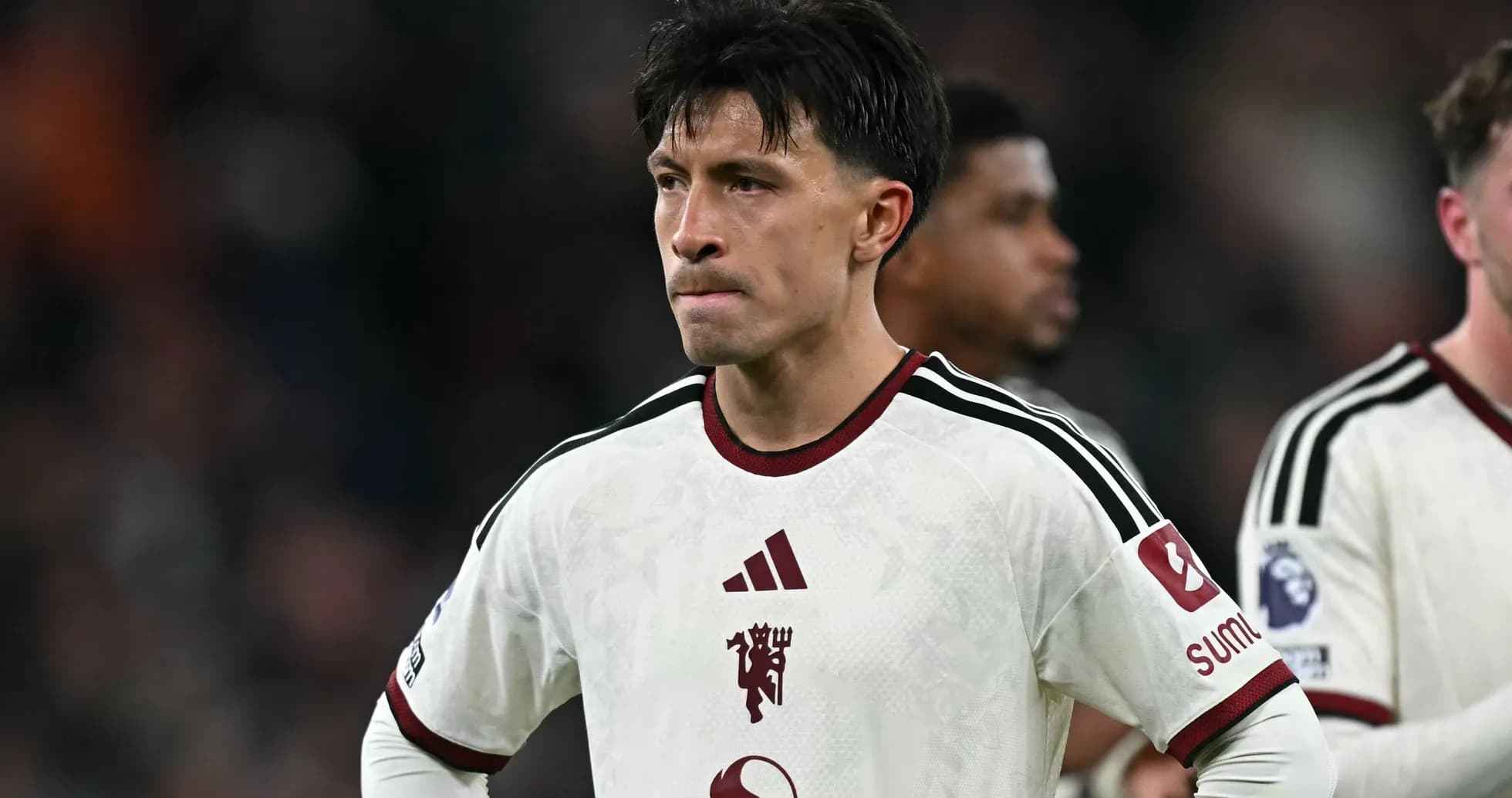
Paul Scholes Criticizes Lisandro Martínez After United's Anfield Collapse
Paul Scholes has rarely tiptoed around Manchester United’s problems. After a 4-0 humiliation at Anfield, he didn’t bother reaching for the sugar-coating. He went straight for Lisandro Martínez.
On a weekend that was supposed to mark a new era under Mauricio Pochettino, United instead served up the most familiar of collapses: naïve, open, and brutally exposed by Liverpool. A red card for Leny Yoro early on gave them an excuse. Their defending gave them none.
“Cheating football”
Scholes’ fiercest criticism landed on Martínez, whom he accused of “cheating” his team-mates in the build-up to Rio Ngumoha’s second-half goal. The moment summed up United’s afternoon: a half-hearted challenge near the halfway line, Bradley Barcola allowed to burst through, and a defence that simply didn’t want to run.
Speaking on The Good, The Bad & The Football, Scholes didn’t soften the language.
“They've got Maguire, De Ligt and Martínez for the third goal yesterday, that's just cheating football because he [Martínez] didn't want to run back,” he said.
For a player who has previously criticised the club’s hierarchy for not signing enough quality, this was a stinging reversal. On Sunday, it was Martínez’s own attitude and physical output that came under the microscope, not the boardroom’s.
Scholes went further, questioning whether the Argentina international has ever been suited to English football’s demands.
“He's not physically right for the Premier League, he just isn't, and we all said that three or four years ago when he signed under Ten Hag.”
It was a blunt verdict, delivered with the authority of someone who has seen United defenders set far higher standards in far more hostile environments than this.
A wider indictment of United’s squad
This wasn’t just about one centre-back. Scholes turned his fire on the broader structure and conditioning of Pochettino’s squad, arguing that United simply cannot live with the athleticism of their domestic rivals.
“The big issue we have is the physicality and the athleticism of this group of players compared to everybody else,” he said.
To underline the gap, he pointed to Brighton. Not as plucky overachievers, but as a benchmark.
“I said the other week when I watched Brighton play, now they are a top-end team right now. They should've won again yesterday with the chances they had, but I've never seen a team that fit.
“It was unbelievable the intensity, I can't imagine when watching United, they're a million miles away from what I saw at Brighton. I don't think it's about application, I just don't think they've got the athletes. I think they can train as hard as they can.”
That comparison cuts deep. United, with their budget, their history, their expectations, being described as “a million miles away” from Brighton in terms of intensity and fitness is not a tactical critique. It is a structural one.
Pochettino’s early reality check
For Pochettino, this was supposed to be a fresh start after Michael Carrick. Instead, Liverpool handed him the worst possible opening chapter: four goals conceded, the defence now statistically the leakiest in Europe’s top five leagues, and all the old questions roaring back.
Yoro’s dismissal will be mentioned in the post-mortems, but Scholes’ analysis went beyond the usual caveats. This wasn’t about being a man down. It was about what United did – or refused to do – when they didn’t have the ball.
Harry Maguire, Matthijs de Ligt and Martínez all came under scrutiny for failing to track runners and recover with urgency. The gaps were not just tactical; they were physical. Once Liverpool punched through the first line, United’s back line looked like it was running in sand.
Now those defenders, and Martínez in particular, face a harsh spotlight. Every duel, every sprint, every recovery run in the coming weeks will be read as an answer to Scholes’ charge of “cheating football” and his claim that this squad simply lacks the athletes to compete.
Pochettino’s job is suddenly very clear and very brutal: toughen this team up, sharpen its edge, and rebuild a defensive unit that has forgotten how to suffer. If he cannot turn that around quickly, the question won’t just be whether Martínez is right for the Premier League.
It will be whether this entire United squad is built for the fight the league demands.