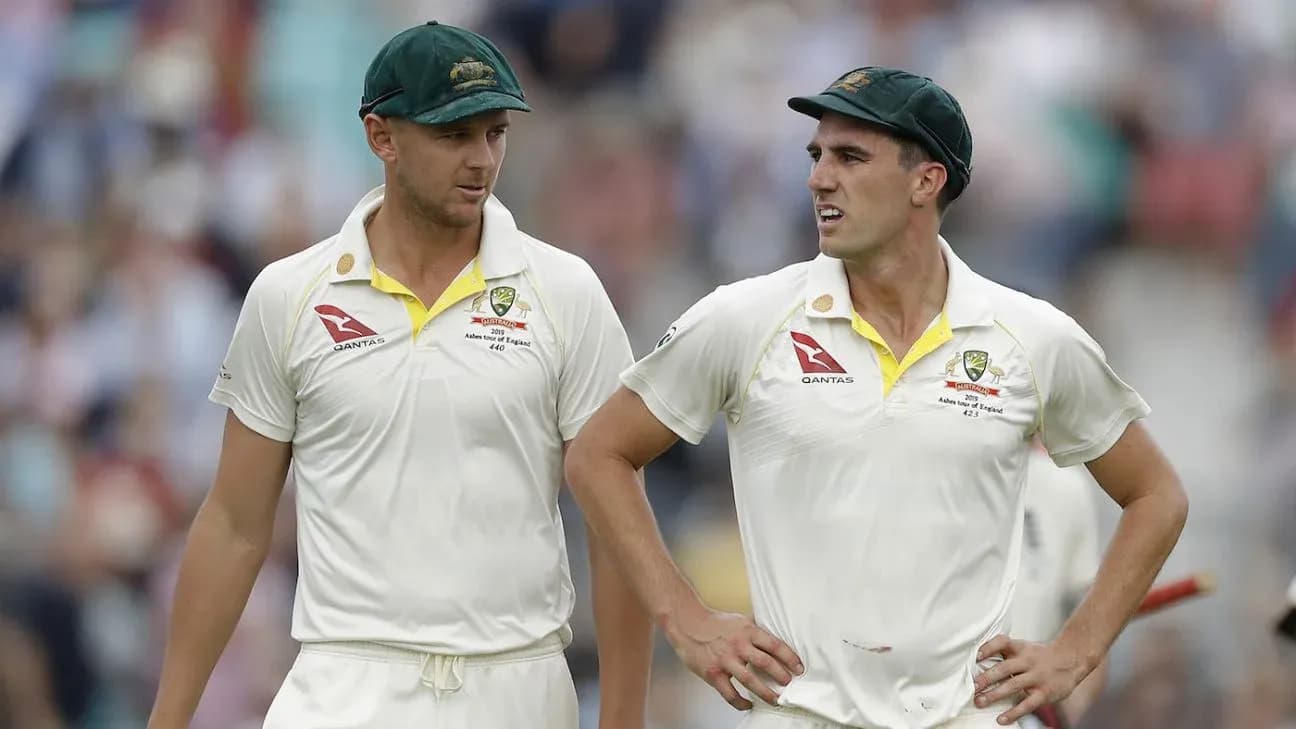
Josh Hazlewood Backs Pat Cummins Amid Sandpaper Fallout
Josh Hazlewood has drawn a hard line in the sand around Pat Cummins and the lingering fallout from sandpapergate, declaring he would consider his future if Cricket Australia moved against the Test captain.
In a forthright interview with News Corp, the fast bowler broke his silence on a chaotic fortnight that has dragged the 2018 South Africa tour back into the spotlight and reopened old wounds inside Australian cricket.
Hazlewood backs Cummins – and his captaincy
Hazlewood has been training alongside Cummins in Sydney ahead of the first Test against New Zealand in Perth, and his loyalty to his captain could not be clearer.
"It feels like it's been a bit of a pile on the last few days from different people," Hazlewood said. "I want to back Pat and everything he said in his press conference last week, everything he's done for the last five or six years in particular as captain."
He pointed to Cummins’ leadership since taking over, arguing that the culture shift under his watch has ensured the game will never again see a repeat of Cape Town.
"To get the group where it is now and in a position where something like that [sandpaper] is never going to happen again - I think is just a remarkable job. He's a great leader. If you went around and asked everyone in the team, you'd hear the same response."
Then came the line that will echo around Australian cricket.
"I think if we turned up for the first Test and he wasn't the captain and it was someone else, honestly, I don't know how that would go."
Pressed on whether he would consider his own place in the side if Cummins was removed, Hazlewood did not dodge the question.
"I think I'd have to be put in that position to make a decision, but you'd have to think about it, yeah," he said.
For now, that scenario looks remote. Cricket Australia is expected to release a statement backing Cummins and reinforcing his position as Test and ODI captain.
A fortnight of revelations
Hazlewood’s intervention comes after a fresh wave of claims and counterclaims triggered by Usman Khawaja’s book Sabr, which reignited scrutiny of the South Africa tour and the events leading to the ball-tampering scandal.
Khawaja’s account prompted Cummins to front a 68-minute press conference, fiercely defending his integrity and rubbishing suggestions he knew about the sandpaper. Cricket Australia then announced an independent forum for players and staff from that tour to privately relive their experiences.
Cameron Bancroft followed with a 4000-word article of his own, detailing his version of how the plan to alter the ball was devised and executed. David Warner has backed Khawaja’s broad version of events, though without offering his own detailed account.
The picture that has emerged from Khawaja, Bancroft, Chadd Sayers and others is of a dressing room where, they say, everyone knew what was going on. What they have not produced is explicit evidence that every player was involved in the key conversations.
Hazlewood is adamant he was not.
‘The answer is no’
The fast bowler leaned heavily on his original testimony in the immediate aftermath of Cape Town.
"We were interviewed straight after [Cape Town] and I trust what I said in that two-three hour interrogation more than anything because it was in the day or two after," he said. "It was fresh in my mind at that point."
Two questions, he argued, cut to the heart of his involvement.
"Was I an architect in the plan to tamper with the ball with sandpaper? And was I aware sandpaper or foreign substances being used on the field? The answer is no. When it boils down to it I think those two points are crucial."
"Assuming everyone knows and actually knowing everyone knows - that gap is huge. That's a big chasm."
Khawaja and Bancroft both say the plan was first discussed at the tea break on day two of the Port Elizabeth Test. Sayers, 12th man at the time, has said he knew of the plan and was asked to collect the sandpaper from Bancroft when he came off the field. Bancroft has also claimed he was using sandpaper every over and asking the bowlers whether the ball was reversing.
Hazlewood pushes back on the idea that such questions implied guilt.
"It's definitely a normal interaction and I read that part [in Bancroft's statement]. I have no doubt that he was asking us those things about the ball reversing. There's not one point in his statement where he says 'Oh, I'm doing this with sandpaper.'
Inside the Port Elizabeth dressing room
A key plank of Hazlewood’s defence lies in the physical and social split he says existed between batters and bowlers at the time.
He described the Port Elizabeth dressing rooms as "quite long and thin" and suggested it was a "genuine assumption" that the bowlers would be at one end and the batters at the other, particularly in a short 20-minute break when the quicks were refuelling and preparing to bowl again.
That division, he believes, helps explain how some players could have missed a conversation others insist involved the whole group.
Like Cummins, Hazlewood said he did not recall the umpires dropping the ball near the boundary rope after tea – a moment Khawaja and Bancroft have highlighted as significant, saying the cameras would not be trained on the team at that point as the plan was put in motion.
What Hazlewood remembers is the ball suddenly talking.
He removed Dean Elgar with his sixth delivery after tea, a ball from around the wicket that angled in and then reversed away to find the edge. Moments earlier, Mitchell Starc had uprooted Hashim Amla’s off stump with a vicious reverse-swinging yorker, also from around the wicket. Mitchell Marsh then chimed in with two more wickets using reverse swing, South Africa tumbling from a strong position to 4 for 28.
To Hazlewood, the praise Bancroft says he received the following morning for "looking after the ball" did not amount to an admission of foul play.
"Looking after the ball is crucial in Test cricket especially in conditions like that, but he hasn't mentioned sandpaper, he hasn't mentioned taking something on the field," Hazlewood said. "It's just well done on looking after the ball."
Gaps in memory, gaps in stories
Hazlewood concedes there are parts of Bancroft and Khawaja’s accounts he simply cannot verify.
He said he had no knowledge of two conversations in Cape Town that both men have described, including one in which Bancroft alleges bowling coach David Saker urged him to keep doing what he was doing to the ball.
"I honestly can't comment on whether that conversation happened or not. I had no knowledge of it," Hazlewood said.
He confirmed that the Cape Town dressing room was split "70-30" by an unusual dividing wall, echoing the description given by Bancroft and Khawaja, and that he was not on their side of the room.
He also said he had no memory of a team meeting after play in Cape Town in which, according to Bancroft, Khawaja and Sayers, the players discussed taking collective responsibility.
One key detail remains unexplored. Neither Hazlewood nor Cummins has been asked why Bancroft, rather than Warner, had become the team’s ball manager by Cape Town, given Warner had held that role in the Durban Test and during the preceding Ashes.
Sympathy for Bancroft, anger at sanctions
For all his disagreement with Bancroft’s version of who knew what and when, Hazlewood expressed clear sympathy for the opener and the toll the scandal has taken on him.
He described the bans handed down to Bancroft, Warner and Steve Smith as "ridiculous" and made it plain he feels for Bancroft in particular and what he has endured since being cast as the on-field face of the saga.
As Cricket Australia prepares to issue yet another statement on a scandal it has never truly escaped, Hazlewood has thrown his weight firmly behind his captain and his own original testimony. The question now is whether that will be enough to steady a dressing room once again forced to relive the darkest chapter of its recent past.