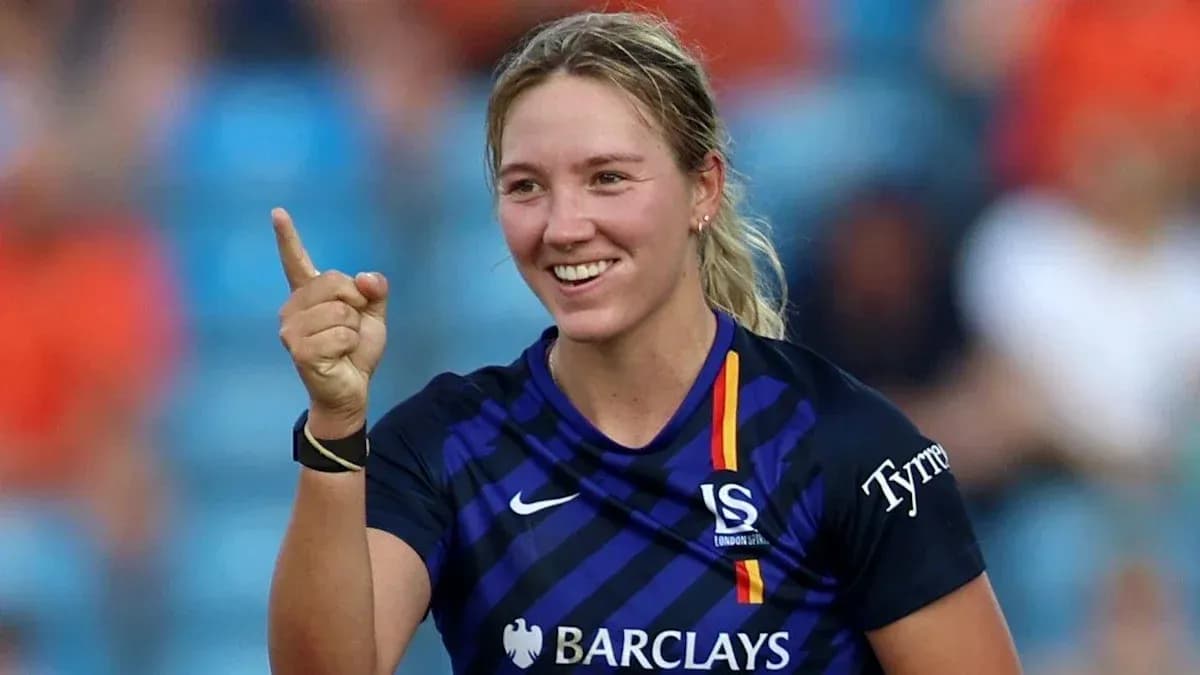
Katie George's Inspiring Journey: From Fast Bowler to Top-Order Batter
Katie George had reached the point every injured athlete dreads. One more rehab, or walk away for good?
By the end of last year, England’s once-express fast bowler was leaning towards the door.
“I had a couple of conversations with my close family and partner about whether it was taking too much out of me and whether I was happy with the person I was,” she says. “I was pretty miserable.”
This is someone who burst into international cricket at 18, a left-arm quick some coaches talked about in generational terms. She debuted for England in 2018, seven internationals crammed between March and July, the sort of whirlwind start that usually signals a long career.
Then her body turned on her.
Nine stress fractures in her back. Torn rib cartilage. Ankle surgery. A grim medical file that would make even seasoned pros wince. Seasons slipped by in scans and rehab rooms.
Stripped of her main weapon and batting little better than a tailender, George clung to squads on the strength of her athleticism and a knack for outrageous catches. She even picked up a tag: “specialist fielder”.
It was meant kindly. It cut deep.
She talks about feeling like an “empty uniform”, a body in a shirt, not a cricketer shaping games. And in the background, a fear gnawed away: that she would become cricket’s version of Daniel Sturridge, the injury-ravaged striker she namechecks, remembered more for what might have been than what was.
“I found that really difficult. I didn't want to be that person,” says George, who played football for Portsmouth as a youngster.
People told her she was resilient, admired how much she had endured. The compliments started to feel like a burden.
“Then when it keeps happening there is pressure and it gets harder. You need to look brave and be resilient and show less emotion than you are feeling. Anyone knows when you bottle that up it can get quite tricky.”
The crossroads arrived at Warwickshire during her end-of-year appraisal. Quit. Or change.
George chose change.
With coach Ali Maiden, she sketched out a plan that looked wildly optimistic on paper. At that point she had more ducks than fifties in professional cricket. Her career identity was bowler-first, everything else a distant second. The idea? Rebuild her as a frontline batter.
Even she didn’t fully buy it.
“I always knew I was half decent at bowling but I never had that feeling for batting,” she says.
Through age-group cricket and into the regional game, there had been glimpses – a fifty here, a fluent cameo there – but no roadmap.
“There were moments where in a game it would come off but I would have no idea how to replicate it. I would always put it down to a fluke.”
The flukes have become a method. And the method has changed her career.
Batting regularly at number three this season, George finished top of the One-Day Cup averages with a remarkable 77.55. She peeled off 98 against Blaze in April, then her first professional century against Lancashire in June. An unbeaten hundred against Durham closed the campaign. She even walked out to open in the T20 Blast.
The “specialist fielder” had turned into a run machine.
“It is crazy it happened but there was a lot of hard work and I am very grateful to Ali,” she says. “He pushed me and challenged me as to why couldn't I change the narrative a little bit. I want to impact games. I don't want to sit on the bench. I can do that from my sofa.”
Impact is exactly what she has earned. Her reward is a ticket to India with England A later this month, a tour stacked with young talent and familiar names. Lauren Filer will be there. Tilly Corteen-Colman too. Her partner Issy Wong was selected but has had to withdraw through injury, a reminder of the fragility that has framed so much of George’s own story.
A few weeks ago, during a team exercise, the squad were asked what they were most proud of. For years, George’s answer would have been simple: her England debut.
Not anymore.
“Once I thought about it, it was actually being stood in that team room as a batter and wearing this kit again,” she says. “If you said I would be here as a batter in England kit I would definitely have laughed and said you were smoking something.”
The temptation now would be to look too far ahead, to map out a clean run of seasons and series. George knows better. Her body has taught her that.
She hasn’t given up on bowling regularly again and has no intention of heeding any cautious voices suggesting she park it.
“It would fall on deaf ears,” she says.
For now, India offers something more immediate: a stage, and an audience. England coach Charlotte Edwards, selector Lydia Greenway and the new managing director of women’s cricket, Leah Poulton, will all be on tour. Every innings is a conversation with the future.
“My dream would be to play a red-ball game for England,” George says. “That is what I set out for do. It is what I watched as a kid with my dad. I vividly remember my first ever Test match watching Jimmy Anderson running in and bowling.
“Whether I am able to, I don't know. Maybe it will be as a batter – that would be the biggest plot twist ever.”
From tearaway quick to top-order batter, from “empty uniform” to standard-bearer for reinvention, George has already delivered one plot twist. The next one might just come with a red ball in her hand – or a bat tucked under her arm, walking out in an England Test.