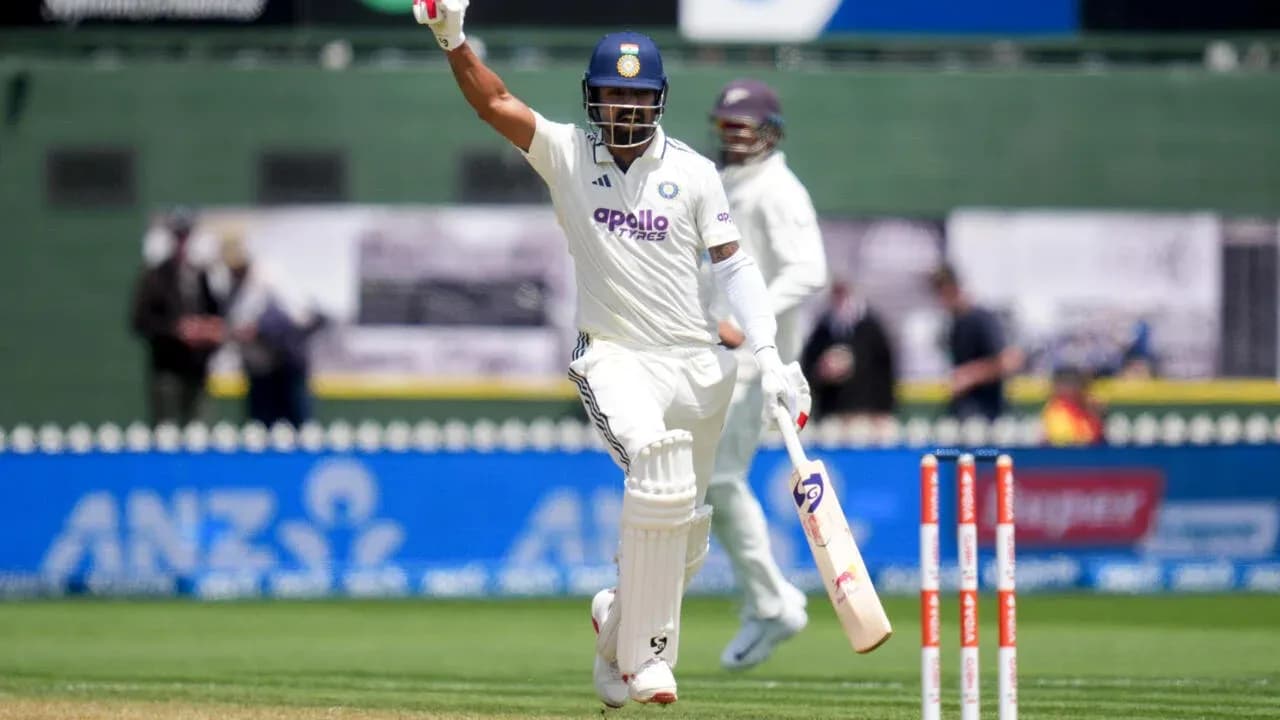
KL Rahul's Historic Century Leads India Against New Zealand
KL Rahul spent the last six or seven months thinking about how to score runs in New Zealand. By stumps in Wellington, he had his answer – and a rare personal landmark to go with it.
On a dry, unresponsive Basin Reserve surface, Rahul crafted a measured, almost old‑fashioned 113 that not only dragged India to safety but also completed a unique circle in his Test career: centuries in every major Test nation outside the subcontinent. He raised his bat, then his fist, to a packed crowd shortly after lunch, a 207-ball hundred built on discipline first, flourish later.
India, who had resumed on 159-1 and 209 runs behind, ended the day utterly transformed. Every member of the top five passed fifty. New Zealand, by contrast, were left staring at a scorecard that read like a slow bleed.
Rahul’s escape, then control
It could have been a very different story. On 5, Rahul looked dead to rights in front, trapped on the crease. Umpire Kumar Dharmasena said no. New Zealand, uncertain, kept their review in the pocket. Replays showed the ball crashing into the stumps.
Rahul called those 15 seconds “the slowest 15 seconds of my life”. They might yet prove the turning point of the match.
From that moment, he shut the door. The first session was attritional, almost stubborn. Rahul defended with soft hands, left everything he could, and waited. Devdutt Padikkal, at the other end, did much the same. New Zealand’s seamers – Matt Henry, Nathan Smith, Kyle Jamieson – beat the bat occasionally, Tom Blundell stood up to the stumps to squeeze any hint of movement, but the pitch refused to cooperate.
Low, slow, and lifeless. Not a single genuine chance created in two hours. India, unhurried, just kept ticking.
As the morning wore on and Glenn Phillips came on with his off-spin, the mood shifted. The surface still gave him nothing: no rough, no real footmarks despite two days of traffic. Rahul sensed it immediately. He launched a clean six straight back over Phillips, then unfurled a deft reverse sweep to move into the 90s. The tempo had changed. New Zealand had no answer.
By lunch, Rahul was 93 not out. India’s deficit had shrunk. The pressure, once entirely on the visitors, had quietly flipped.
Padikkal, Jaiswal and a top order in sync
Rahul’s hundred, when it came after the interval, felt inevitable. He soaked in the applause, held his pose, and then went back to the grind.
Padikkal, playing with the calm of a veteran rather than a man still building his Test résumé, matched Rahul’s composure. Their 165-run stand spanned 55 overs and effectively broke New Zealand’s spirit. Padikkal’s 80 ended only once the new ball arrived and Jamieson finally found a way through, hitting the stumps to offer the hosts a rare moment of relief.
By then, the pattern of India’s innings was clear. Yashasvi Jaiswal’s rapid 85 on the second evening had set the tone, battering New Zealand off their lengths and putting India “ahead of the game”, as the scoreline now underlined. With Rahul at three and Padikkal at his side, India’s top order formed a relentless, four-session wall.
Each of the top five crossed fifty. On a surface this benign, it felt less like a fluke and more like a statement.
Gill’s heartbreak, Pant’s fireworks
The late drama belonged to Shubman Gill. He walked out at tea on 36 not out, looking increasingly assured, and powered his way towards a hundred that seemed there for the taking. He and Rishabh Pant added a vibrant 100-run stand in the final session, Pant turning the screws with his usual disdain.
Jacob Duffy bore the brunt. Pant picked him off at will, hammering a flurry of sixes over deep square leg and turning what had been a day of attrition into a late-evening exhibition. New Zealand’s fields scattered, plans dissolved. The ball kept disappearing into the crowd.
For Duffy, the numbers were brutal. By stumps he had 1-180 from 29 overs – the fourth most expensive figures in New Zealand’s Test history. A harsh line in the book for a seamer asked to toil on a pitch that refused to misbehave.
Jamieson, by contrast, emerged with credit. His 1-57 came with control and threat, the best of the home attack, while Henry’s 1-70 felt like a fair reward for long, hard overs into the breeze. But none of them could find a sustained way through.
Just when it looked like New Zealand would finish the day without further joy, they finally prised open a crack. Gill, on 98, played one shot too many and lost his off stump to Duffy, three balls before the close. A 146-ball innings, full of balance and timing, ended two short of the milestone he craved.
The Basin fell momentarily quiet. Gill trudged off, bat tucked under his arm, leaving Pant unbeaten on 55 and nightwatchman Anshul Kamboj on 0 to return in the morning.
A series tilting India’s way
Across two days, New Zealand have watched the surface flatten and their advantage dissolve. The bowlers have pounded away, but the pitch has offered almost nothing: no seam, barely a hint of spin, and footmarks that refuse to form. India, patient and ruthless, have cashed in.
Rahul, who spent months studying how visiting batters succeed in these conditions – watching England, Australia, West Indies bat here – now has his own template, and a cherished entry on his personal honours list.
The two-match series moves to Christchurch next week. New Zealand need a response. India, with their top order in full voice and their senior opener freshly crowned across the cricketing map, look increasingly ready to dictate the terms.