Liam Lawson Shines as Las Vegas Circuit Dries Out
Liam Lawson arrived at a very different Las Vegas on Saturday – one with grip, rhythm and, at last, some answers.
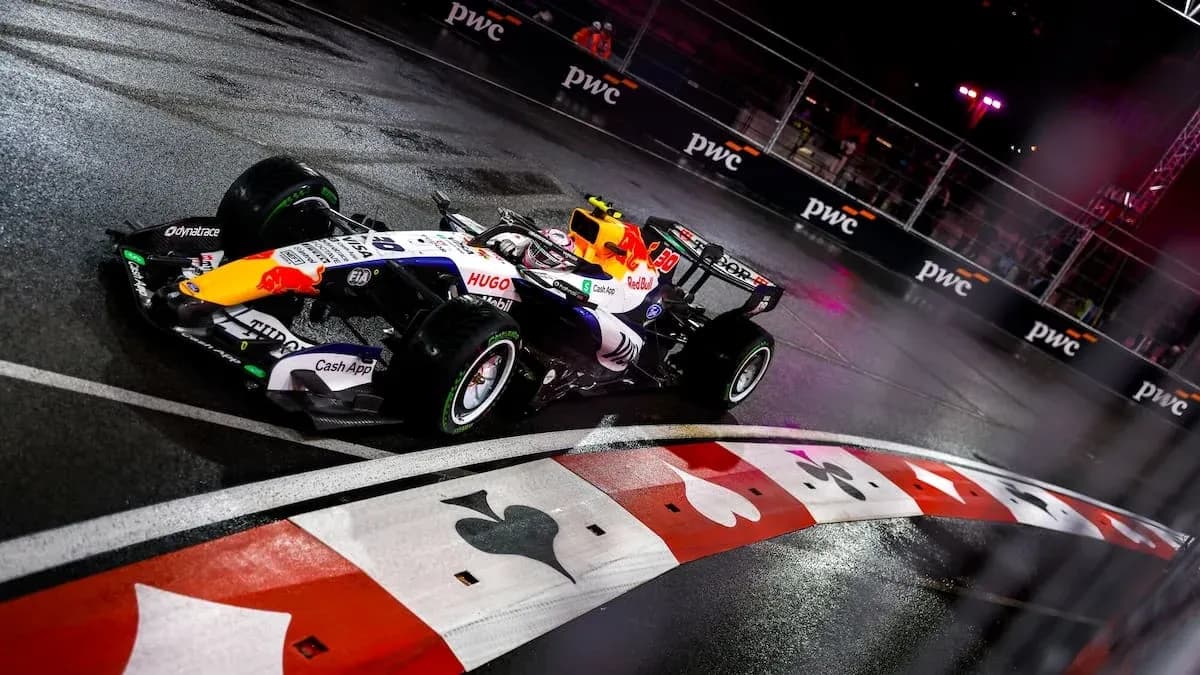
After a soaked and largely wasted opening day on Formula One’s return to the Strip, free practice three became the only meaningful read on pace before qualifying. Lawson made it count. The Racing Bulls driver punched in the seventh-fastest time, a 1m 35.402s, and looked increasingly at ease as the circuit finally came to him.
He finished ahead of teammate Arvid Lindblad, who took 10th with a 1m 35.450s, a solid marker for the rookie pairing after Friday’s near-write-off.
Top Performers
Up front, Mercedes laid down an ominous benchmark. George Russell topped the session with a 1m 34.041s, with teammate Kimi Antonelli slotting into second on 1m 34.952s. On pure pace, the silver cars owned FP3.
But the grid sheet for Sunday will tell a different story.
Antonelli, the newly crowned world champion, will carry a five-place grid penalty for engine changes. Lance Stroll (Aston Martin), Oscar Piastri (McLaren) and Carlos Sainz (Williams) are all braced for 10-place drops, while Haas rookie Ollie Bearman is consigned to start from the very back.
Those penalties, especially for Antonelli and Piastri, blow a hole in the usual running order and quietly clear space for opportunists. Lawson is one of them. A top-10 start is suddenly not just hopeful thinking; it is firmly in play if he strings together a clean qualifying.
That prospect felt distant 24 hours earlier. Free practice one on Friday night was a non-event for Lawson and Lindblad. With heavy rain drenching the temporary street circuit, Racing Bulls never even rolled the dice. They were two of five drivers who stayed in the garage for the entire session, banking on better conditions rather than meaningless laps on a treacherous surface.
Free practice two didn’t immediately rescue the situation. The hour began with cars tiptoeing out on full wet tyres, searching for grip on a track that refused to dry on cue. Only when the surface finally came around for intermediates did Racing Bulls commit, sending their cars out with about 30 minutes left.
By then, the clock was already winning. Lawson managed just 12 laps, hardly a database for a team trying to understand a new street circuit. The laps they did gather came in conditions unlikely to be repeated across the rest of the weekend, limiting their value even further.
All of which raised the stakes for FP3.
When the pit lane light turned green on Saturday afternoon, there was no hesitation. Cars queued at the end of the lane, drivers eager to claw back lost time, engineers desperate for data. Racing Bulls joined the rush, and Lawson set about compressing a weekend’s worth of learning into one session.
He didn’t get everything he wanted. A final push lap at the end of FP3 slipped away as the session clock hit zero. But the damage – or in this case, the groundwork – was already done. Lawson logged 31 laps, a crucial haul on a layout that punishes hesitation and rewards confidence in the braking zones.
One corner in particular stayed on his mind: turn 14. Lawson flagged an issue with his braking there, something he wants to dig into between sessions. On a street track, where one misjudged marker can end a weekend against the wall, that kind of detail matters.
The raw times say seventh place. The context says something more important: a driver trending upwards at exactly the right moment, on a circuit where chaos, penalties and narrow margins can transform a strong practice into a career-shaping grid slot.
Qualifying will show just how far Lawson can push that momentum. In Las Vegas, under the lights and with the deck reshuffled by penalties, the opportunity is there. Now it is about who has the nerve to grab it.