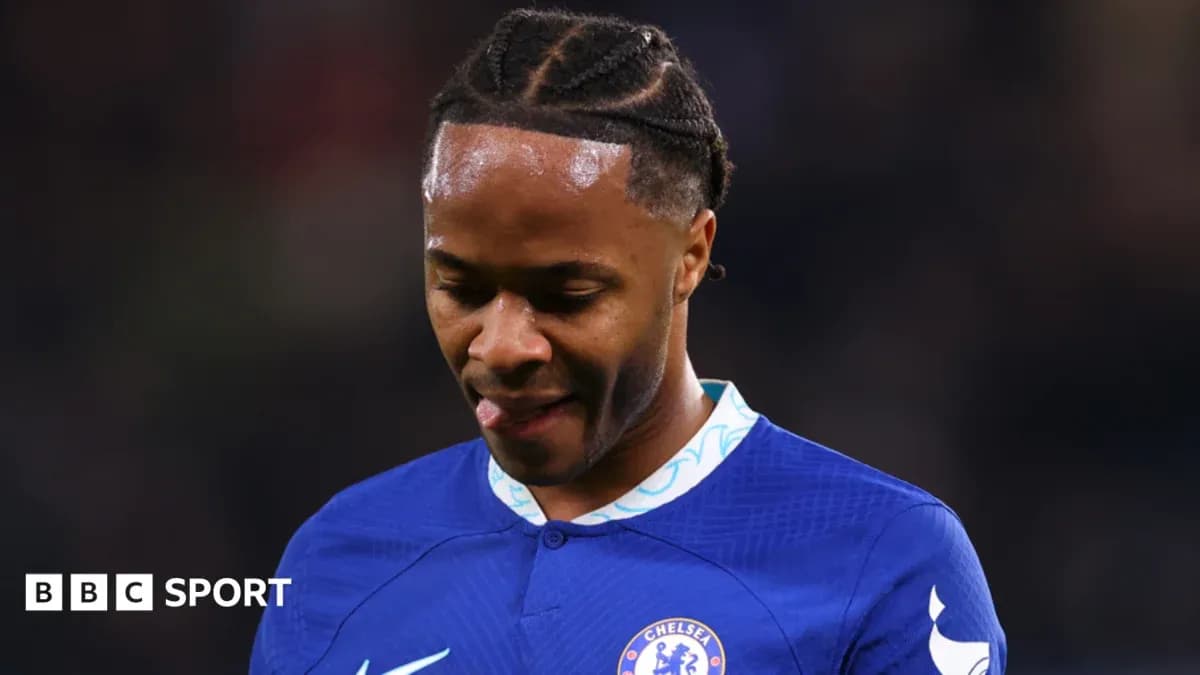
Raheem Sterling: From Football Star to a Career at a Crossroads
Raheem Sterling grew up in the shadow of Wembley’s arch, close enough to see the stadium lights cut through the north-west London sky. Years later he stood beneath that same arch as a starter in a European Championship final for England. From concrete estate to the centre of the national stage – his rise once felt like the definitive modern English football story.
Now, at 31, that story hangs in the balance.
Sterling has been handed a 12-month prison sentence, suspended for 18 months, after admitting dangerous driving. He has been banned from driving for two years and ordered to complete 100 hours of unpaid work. The judgment followed a motorway crash on 28 May, when he lost control of a Lamborghini, causing what the court heard was “substantial” damage to the car and all four wheels, leaving it undriveable.
He also admitted possessing nitrous oxide for wrongful inhalation and failing to provide a specimen for analysis. For a player who once came to symbolise control, discipline and relentless upward movement, the details were stark.
From Neasden to England’s frontline
Sterling’s life has never followed an easy route.
Born in Kingston, Jamaica, he was two when his father was shot dead. His mother, Nadine, determined to carve out a safer future, moved to England first, working in hotels cleaning bathrooms and changing bedsheets while finishing her education and searching for a home. Only then did she bring Raheem and his sister over to join her.
They settled on a housing estate in Neasden. Sterling’s school days were turbulent. He spent part of his education at Vernon House, where staff tried to manage a boy whose mind was rarely anywhere but on a football. In a candid Players’ Tribune piece in 2018, he admitted: “I was so naughty that they kicked me out of primary school. I just didn't like to listen to anyone but my mum. That was my problem.”
One teacher, Chris Beschi, saw both the risk and the potential. When Sterling was 10, he told him: “If you carry on the way you're going, by the time you're 17 you'll either be playing for England or in prison.” It sounded like a line from a film. For years, it looked like Sterling had chosen the brighter of those two paths without ever looking back.
Liverpool signed him from Queens Park Rangers for £600,000 in February 2010, a substantial outlay for a 15-year-old. Two years later he was in the first team. At 17, he became Liverpool’s second-youngest goalscorer, behind Michael Owen, when he hit the winner against Reading in October 2012. His acceleration, the way he slipped through gaps and rode challenges, marked him out as something different.
By November 2012, aged 17 years and 342 days, he was making his England debut in Stockholm on the night Steven Gerrard won his 100th cap. Sterling would go on to earn 82 caps and score 20 goals, appearing at three World Cups – 2014, 2018 and 2022 – and two European Championships.
Euro 2020, delayed to 2021, was his tournament. While others wilted under the weight of expectation, Sterling drove England forward. He scored key goals, carried the ball up the pitch when nerves frayed, and was named in UEFA’s team of the tournament as England reached the final at Wembley, losing to Italy on penalties. On his forearm, a tattoo of a young boy holding a football and gazing up at the Wembley arch seemed to have come to life.
City, medals and an MBE
In 2015, Manchester City paid up to £49m to prise him from Liverpool, making him the most expensive English player of all time. He had turned down a new deal at Anfield, choosing the Etihad and the promise of trophies. Manuel Pellegrini called him “one of the best attacking players in world football” when the move went through. Over the next seven years, Sterling did plenty to justify the claim.
He scored 131 goals in 339 appearances for City in all competitions. He became a central figure in a side that dominated English football, winning four Premier League titles, five League Cups, an FA Cup and a Community Shield. Under Pep Guardiola, his movement sharpened, his numbers soared, his reputation hardened. Sterling wasn’t just quick; he was ruthless.
Recognition came away from the pitch as well. In 2021, while still at City, he was awarded an MBE in the Queen’s Birthday Honours for services to racial equality in sport. Sterling had become one of the most prominent voices in English football on issues of race and representation.
“I am grateful to have been recognised,” he said at the time. “But my priority is to try to help to educate society and myself. I'm learning every day.” The words matched the image: a player who had outgrown the stereotype of the mercurial winger and stepped into a wider role.
Chelsea, Tuchel and a stalled second act
By the summer of 2022, Sterling’s medal collection was overflowing. Ten major trophies under Guardiola, a central role with England alongside Harry Kane, and the sense of a player in complete command of his career. When Chelsea came calling with a £50m offer, it looked like the next big chapter rather than a risky detour.
Thomas Tuchel, then Chelsea manager and now in charge of England, wanted him above anyone else that window. New owners Behdad Eghbali and Todd Boehly backed that judgment in the first major move of the post-Roman Abramovich era. Sterling was riding the crest of a wave, swapping Manchester for west London with a clear plan in mind.
Those close to him speak of how strongly Tuchel’s vision pulled him south. The German had mapped out a defined role, a structure built around Sterling’s strengths, and a leadership position within a younger squad. Sterling was not just signing for Chelsea; he was signing for Tuchel’s Chelsea.
Two months later, Tuchel was gone. Graham Potter came in. The project shifted, then shifted again.
Sterling’s Chelsea career never truly settled. Over four years he managed just 45 Premier League starts. He spent 18 months in the club’s so-called “bomb squad”, training away from the core group as the squad ballooned and priorities changed. A season-long loan to Arsenal in 2024-25 offered the chance of a reset, but it never really caught fire.
On the pitch, he looked like a player searching for rhythm in a world that had moved on. Off it, he continued to invest in causes he believed in, launching a scholarship fund aimed at narrowing the gap in university access for black British students. The public figure remained serious, socially engaged, aware of his platform.
The footballer, though, was no longer the unstoppable force he once seemed.
A career at a crossroads
Across his club career, Sterling has commanded around £100m in transfer fees, played for Liverpool, Manchester City, Chelsea and Arsenal, and carried the hopes of a nation at major tournaments. He has lived the extremes of the modern game: from a Neasden estate to the Etihad trophy parades, from Wembley finals to royal honours.
Now he faces a different kind of scrutiny.
A 12-month suspended sentence, a driving ban, unpaid work – these are not the usual markers of a veteran star gently easing towards retirement. They are the signposts of a career that has veered off its intended route.
It would be simplistic to pin Sterling’s recent struggles solely on Tuchel’s sacking, or on any single moment. Football careers rarely collapse in one blow. They erode, twist, get nudged off course. But the contrast is stark: the player who once looked like England’s most reliable attacking outlet, who once embodied control in chaotic games, now finds his own life edging towards disorder.
The boy who was told at 10 he would end up either playing for England or in prison chose England, and did so spectacularly. The question now is whether this latest chapter is a jolt that pulls him back towards the standards that defined his peak, or the point where one of the most compelling careers of his generation begins to fade for good.