Sarfaraz Khan: The Alleged Mole and His Journey Back
Sarfaraz Khan still remembers the moment his phone wouldn’t stop buzzing.
The Border-Gavaskar Trophy had wrapped up weeks earlier. He had flown back from Australia, carrying the quiet frustration of a tour where he never made the XI and an injury that had sent him straight to the National Cricket Academy. The noise, he thought, had died down.
It hadn’t.
By the time his flight landed, social media had turned him into the alleged mole of the Indian dressing room.
A Storm After the Silence
Reports of tension inside the Indian camp during the 2024-25 tour of Australia had already started to swirl. India had been outplayed in Melbourne, and stories emerged of head coach Gautam Gambhir tearing into the squad after the fourth Test defeat. Somewhere in that fog of anger and speculation, a more personal narrative was born: someone, it was claimed, had leaked details from inside the room.
The finger, unfairly and without proof, pointed at Sarfaraz.
For a player who hadn’t even got a game in the five-Test series, the accusation cut deep. He was rehabbing, out of the spotlight, and suddenly painted as the man who had betrayed the sanctity of the dressing room.
“I was hurt,” he recalled in an interview with Aakash Chopra on YouTube. “The moment my flight landed, I started getting calls and messages. A lot was written on social media.”
The Border-Gavaskar Trophy, he pointed out, had ended 20–25 days earlier. The injury had taken him to the NCA. The controversy found him anyway.
Gambhir’s Call
Just when the noise threatened to drown him, the most important call came from the man at the centre of those dressing-room stories.
Gautam Gambhir didn’t text. He didn’t wait for the storm to pass. He picked up the phone.
“I had to switch off my phone,” Sarfaraz said. “GG sir called me twice. He told me that these are useless talks and not to get involved in this politics and focus on your game.”
The words mattered. The timing mattered more.
Sarfaraz could handle the criticism aimed at him. Cricketers in India learn early to live with opinion. What he couldn’t ignore was the damage being done at home.
“I told him that I can understand it, but my father is sad, and even my wife has been crying,” he said.
Gambhir didn’t stop at consoling the player. He went straight to the source of that pain.
“GG sir spoke to my father and told him to stop giving importance to such talks and let Sarfaraz play cricket, as he is a good cricketer. He told my father to call him if he needs any help. He was the first one to call me,” Sarfaraz added.
In a week where his name trended for the wrong reasons, the India head coach’s public silence contrasted sharply with his private backing. Inside the camp, that support can define a career. At home, it calmed a family.
Denial and Doubt
Sarfaraz has been clear and unwavering: he did not leak anything from the Indian dressing room.
“Whom should I tell? Nothing of this sort happened,” he said. Then he pointed to the one thing cricket always respects – selection.
“If it were the case, I would not have been selected for the India A team and then for the Sri Lanka series. I don't know who said this. I was feeling bad, and if I was calling someone, my call was not answered. It was a bad time for my family.”
He knows his career has never followed an easy script. “My life is full of struggle, and I was ready to face it,” he said. The problem this time was not the grind of domestic cricket or the wait for a Test cap. It was watching the people closest to him carry the weight of something he insists he never did.
“I feel bad for my father, mother, wife and brother. Even a small thing turns big on social media,” he reflected. Then he reached for a line that has clearly stayed with him: “I heard a saying long ago. If you can't spoil someone's work, spoil their name. The work will get spoiled automatically.”
For a middle-order batter who has had to fight for every opportunity, the idea of his name being tarnished cut as sharply as any on-field failure.
A Career Still Waiting to Settle
Strip away the noise and Sarfaraz’s numbers tell the story of a player still at the start of his international journey.
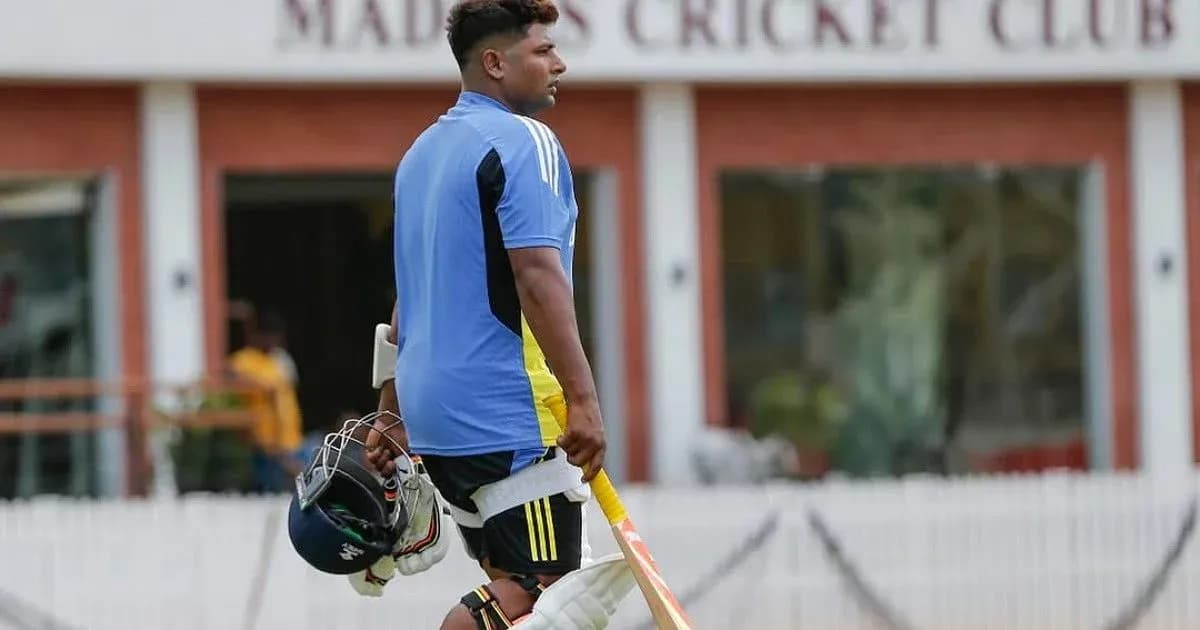
He has played six Tests for India, scoring 371 runs at an average of 37.10, with one century and three half-centuries. His last appearance came at the Wankhede Stadium in November 2024, against New Zealand, a venue that knows his game and his story better than most.
He travelled to Australia as part of the squad for the Border-Gavaskar Trophy but never crossed the rope. He then found himself back in the headlines for reasons that had nothing to do with runs or technique.
The selectors have not turned away. He was picked for India A and later called up as an injury replacement for Sai Sudharsan in the 2026 Sri Lanka Test series, though he did not make the XI in either match. In the IPL, he continues to represent Chennai Super Kings, carrying the label of a middle-order batter with heavy domestic pedigree and unfinished international business.
Beyond the Rumours
For all the noise around leaks and rifts, the most telling detail from this episode might be the simplest: when the accusations flew, the India head coach backed his player, publicly through selection and privately through direct, personal support.
Sarfaraz has worn the backlash, defended his name, and moved on to the one thing he can still control – his cricket. The question now is not what he said in a dressing room, but how loudly his bat will speak the next time he finally gets to walk out in India colours again.