Steve Smith's Uneasy Return to No.3 at SCG
Steve Smith walked out at No.3 at the SCG with more riding on his innings than a routine Sheffield Shield knock. This was an audition – for himself, for the selectors, and for an Australian top order suddenly full of questions.
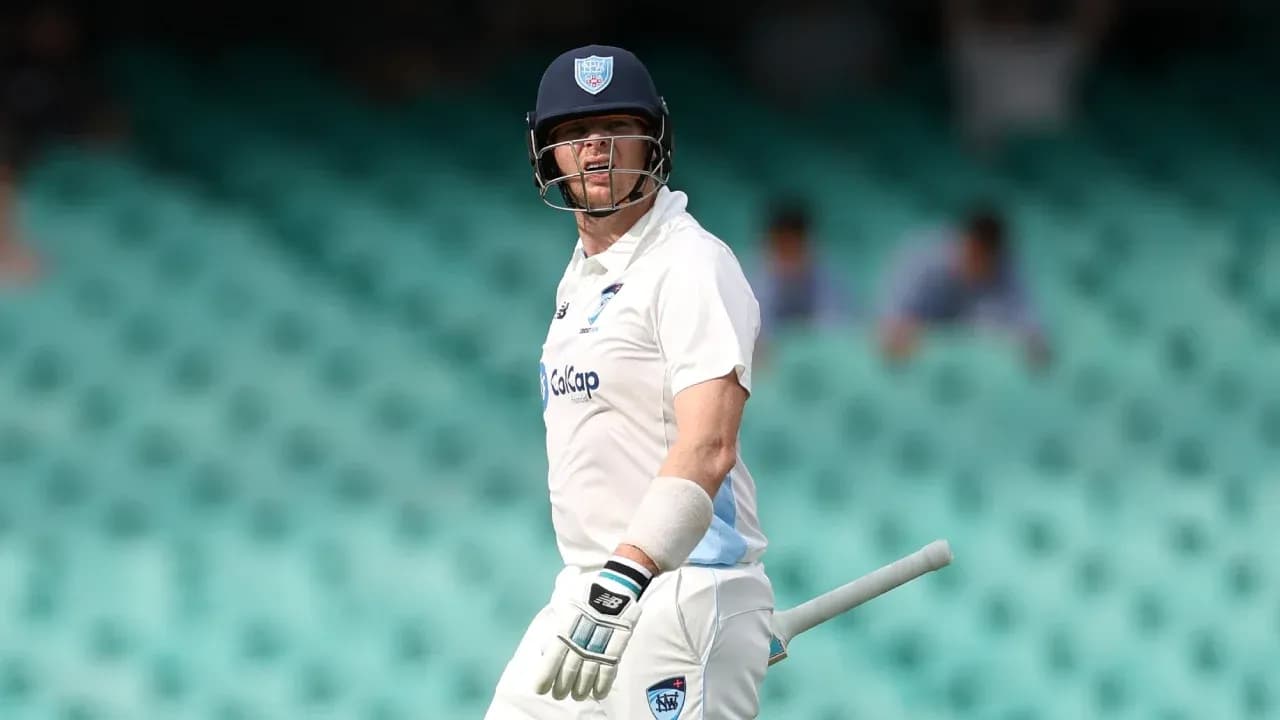
He left with 12 from 59 balls, a sore neck seemingly under control, but no statement score to silence the noise.
Smith’s uneasy return to No.3
For the first time in two years in red-ball cricket, Smith slotted in at first drop, a move that has become the talking point of Australia’s summer before a ball has been bowled against New Zealand.
He survived a huge shout first ball, Mitchell Swepson pinning him on the crease and turning half of New South Wales’ hearts to stone. The umpire said no, Smith settled, and for a while it looked like he might grind his way into rhythm.
The rhythm never came.
On a rain-affected day, he scratched, prodded and resisted, but rarely looked at ease. Then Michael Neser, himself part of the wider Australian conversation, jagged one back sharply. Smith was trapped in front. Replays suggested the ball was sliding down leg, but the decision stood. A long, slow walk off, 12 from 59, and no hint that the old fluency had fully returned.
The neck that ruled him out of the deciding Test in Cape Town didn’t appear to trouble him. The timing did.
Smith’s recent Test returns have been modest by his standards, against Bangladesh and South Africa, with the neck complaint flaring in Gqeberha. Yet as Australia try to claw their way into another World Test Championship final – they sit second after New Zealand’s draw with India – his role looms as central to both selection debates and on-field fortunes.
The case for Smith at No.3
Australia’s top order collapsed in Gqeberha and Cape Town, costing them the series against the Proteas and exposing a brittle core. That’s why Kayo Cricket analysts Mike Hussey and David Warner have joined the chorus pushing for Smith to anchor the innings at No.3.
The logic is simple. Smith at three, Cameron Green at four, Travis Head back to five, Josh Inglis at six, and a fresh opener alongside Matt Renshaw. A sturdier spine, more depth, and a defined role for each.
“That’s the way I’d personally go, I feel like that’s a really strong middle order in particular,” Hussey said at Kayo Cricket’s launch in Sydney earlier this month. He acknowledged Smith’s preference not to bat at three, but the former Test star sees an opportunity: a vacancy for a specialist opener and a more balanced batting card.
If Head, who has peeled off four centuries as an opener in the past year, drops back to No.5, someone new must walk out with Renshaw. That’s where Monday at the SCG mattered.
Konstas and Patterson miss their moment
Sam Konstas and Kurtis Patterson both had the stage, the conditions, and the context to force the selectors’ hand. Neither did.
Konstas, 21, has been one of the stories of the Shield season. Two centuries already, including an unbeaten 151 against Western Australia at the WACA against an attack featuring Jhye Richardson, Joel Paris and Corey Rocchiccioli, then a stirring 173 against South Australia last week. His name has quietly returned to national discussions after a modest stint in the Caribbean last year.
On Monday, after New South Wales bowled Queensland out for 278, Konstas again looked composed. He worked his way to 42 from 86 balls, in control, leaving well, picking off anything loose. Then came the lapse. Swepson floated one up that barely qualified as a threat. Konstas miscued, top-edging a simple return catch. Swepson almost apologised with his muted celebration. A soft dismissal on a day that demanded steel.
Patterson’s story carried its own frustration. Listed at No.4, he has been the most prolific No.3 in Shield cricket since the pandemic at domestic level, and would almost certainly have toured South Africa if not for a groin injury in September. That vacancy instead reopened the door for Nic Maddinson, who struggled against Kagiso Rabada and failed to nail down the spot.
Patterson began this season with a century against Western Australia, but runs have dried up since – just 86 in his next five innings. At the SCG, he battled through tricky, overcast conditions, faced 86 balls for 32, and then lost his off stump to Swepson. Again, a start, again no conversion. On a day when the selectors were watching, that hurts.
Jack Clayton, who had earlier pushed his name forward with a fine century against Victoria, also failed to back up his case, dismissed on Sunday. One by one, the fringe candidates blinked.
Lyon, Swepson and the spin subplot
While the batting auditions stole the narrative, the SCG surface quietly began to offer something more intriguing. It started to turn.
Nathan Lyon, 39, is fighting a different kind of battle – not for selection, according to coach Andrew McDonald, but for rhythm and authority after a rare and bruising stretch. Dropped in Gqeberha for Scott Boland, Lyon missed his first red-ball Test in 13 years when fit. In Cape Town he bowled tightly but without the cutting edge that has defined his career, as Simon Harmer out-bowled him on the final day at Newlands.
Back home, Lyon has insisted he feels stronger than ever since returning from the serious hamstring injury that ended his Ashes in Adelaide, where he still took five wickets. The numbers lately haven’t matched the rhetoric. He went wicketless in the first innings against South Australia before taking three in the second, and at the SCG he toiled for 1 for 86 from 29 overs after a fruitless opening day.
On Monday, though, there were hints. Swepson found turn. So did Marnus Labuschagne with his part-time leg-breaks. As the pitch wears, Lyon will come more into the contest in Queensland’s second innings, and he knows it. McDonald has already made it clear: Lyon will be in Perth for the first Test against New Zealand. The veteran off-spinner wants more than a squad spot. He wants a statement spell.
National stakes across the Shield
The selection picture isn’t confined to Sydney. In Perth, Cameron Bancroft, back in the headlines after revisiting his memories of the 2018 Cape Town scandal, will have his own chance to remind selectors of his value when Western Australia bat against Tasmania at Optus Stadium. WA off-spinner Corey Rocchiccioli, with an eye on both a home Test and the Border-Gavaskar Tour of India in January, picked up an early wicket as Tasmania came under pressure in the first two sessions.
Victoria face South Australia in the final Shield match starting Tuesday, another game where every innings, every spell, feeds into George Bailey’s looming decision on the squad to face New Zealand in four Tests this summer.
Ollie Davies, who lit up the SCG with a blistering 253 against Tasmania in the season opener and followed it with half-centuries against South Australia and Western Australia, is absent from this round with a finger injury. His untimely layoff dents any hope of a late, left-field push for a Test berth.
Amid calls for regeneration in a side dominated by players over 30, McDonald has been consistent: selection will be driven by one thing – reaching a third straight World Test Championship final. Youth is a bonus, not a prerequisite.
Which brings it back to Smith.
He is 37. His neck has been troublesome. His recent numbers are human rather than historic. Yet as the Shield grinds on, as Konstas, Patterson, Clayton and others jostle and stumble, one truth still hangs over the summer.
For all the noise about fresh faces and new orders, Australia’s hopes of walking out at The Oval in June may still rest on the bat of the man who walked off the SCG with just 12 to his name, and the weight of a nation’s top order on his shoulders.