Carolina Dominates Monmouth with Strong Depth and Defense
The scoreline said 85–45. It still felt even more lopsided than that.
Carolina never trailed, never really bent, and rarely even looked bothered as it breezed past Monmouth on Monday night at the Smith Center. Twelve different Tar Heels scored. The outcome was decided long before the horn; the rest of the evening became a showcase of depth, defense and a little bit of the program’s past.
Roy Williams used to have a simple explanation for nights like this: sometimes you’re just more gifted and talented. This was one of those nights.
Brown keeps rolling, Malone nitpicks
Terrence Brown is playing like a man determined to make every box score look the same. For the third straight game, he cleared the 20-point mark, finishing with 20 points, four rebounds and three assists. He got to his spots, rose up in rhythm, and dictated the tempo whenever he felt like it.
If there was any irritation on the Carolina bench, it was reserved for Michael Malone’s four turnovers. A couple were too casual, the kind of loose possessions that won’t go unnoticed on film. On a night with a 40-point cushion, that’s what passes for drama.
A loaded crowd and a loud ovation
Before the ball even went up, the night already felt like a reunion. Monmouth head coach King Rice and assistants Brian Reese and Shammond Williams — all former Tar Heels — were recognized during pregame introductions and received a warm ovation.
Look around the building and the alumni roll call kept growing: Rasheed Wallace, Kenny Smith, Tyler Zeller, Luke Maye, Jimmy Black, Phil Ford, Jason Capel. If you wanted a pickup team of Carolina greats, you could have built a pretty good one from the seats alone.
Defense strangles Monmouth’s offense
Carolina entered the game already defending at a high level, holding opponents to 36.2 percent shooting from the field. Those numbers are about to look even better.
Monmouth managed just 25.8 percent overall and a staggering 9.1 percent from three. Every catch felt rushed, every shot contested. The Mountain Hawks never found a rhythm; most of the time, they barely found the rim.
The first half, in particular, will linger in their record book for all the wrong reasons. They shot 15.6 percent from the floor, the second-worst half of shooting by any team in Smith Center history. Their 15 first-half points ranked as the fifth-lowest total ever in the building.
Carolina helped write those numbers with relentless pressure, but Monmouth’s own struggles turned the game into a rout before halftime.
A 17–0 punch to close the half
The Tar Heels didn’t just build a lead. They stepped on it.
Closing the first half on a 17–0 run, Carolina watched Monmouth miss its last 12 shots of the period. Every stop seemed to ignite a break, every defensive stand fed the margin. What had been a comfortable advantage swelled into something emphatic.
By the time both teams headed to the locker room, the contest had shifted from competitive game to controlled scrimmage.
Rebounding box checked
If there was one statistical category that had quietly nagged at Carolina, it was rebounding. They had been outrebounded in three straight games, flirting with a bit of unwanted history: the last time they’d lost the battle on the glass in four consecutive outings was more than a decade ago.
That streak ended decisively. The Tar Heels posted a 42–36 edge on the boards, winning the rebounding battle and restoring some normal order in the paint. It wasn’t flashy, but it mattered.
Bench makes its mark
The scoreboard gave Michael Malone the freedom every coach craves in November: meaningful minutes for the bench.
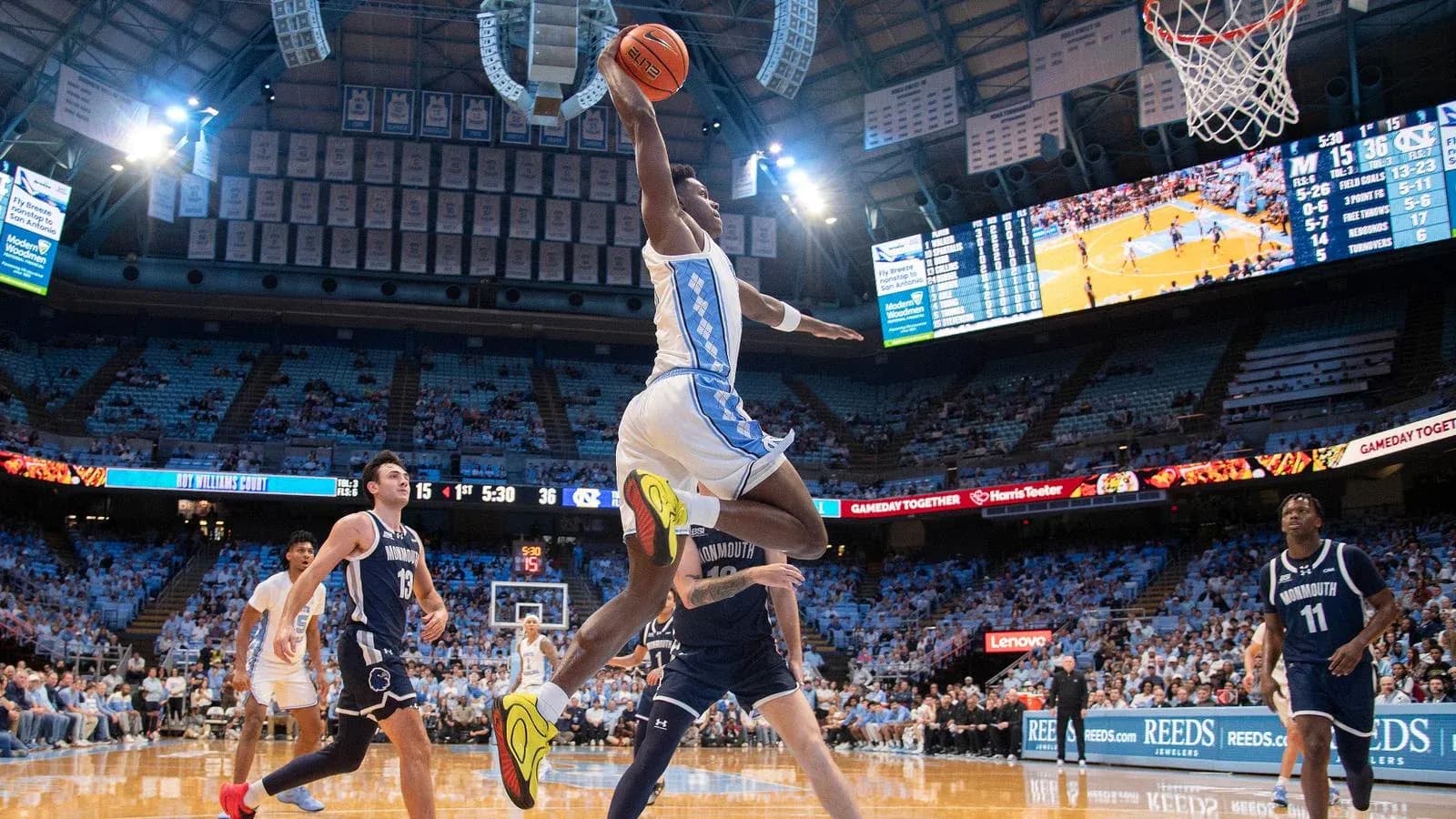
Freshman Kevin Thomas took that invitation and attacked it. He drove hard, finished with an athletic dunk, and calmly knocked down a pair of free throws. His impact, though, went beyond the highlights.
“I was really happy for Kevin,” UNC assistant coach Chuck Martin said in his Tar Heel Sports Network halftime interview. “He came in and impacted the game right away and it wasn't just the dunk. He also stopped the ball one on one on defense on three or four possessions, got in the gaps, and really played well.”
Thomas finished with six points, but the tape will show something more important: a freshman who looked ready to belong.
Samodurov slows the game down
Alex Samodurov delivered the most complete performance of his young Carolina career. In the first half alone, he buried a three, scored on a composed drive with a smooth ball fake, then stepped out and drilled another three.
For stretches, it looked like the game finally slowed down for him. He read closeouts, rebounded in traffic, and played with a calm that hasn’t always been there. By the end of the night, he had stacked up a 10-point, 11-rebound double-double in 25 minutes — his most consistent outing as a Tar Heel.
Now comes the next step: doing it when the jerseys across from him belong to a stronger opponent.
Walk-ons get their moment
Blowouts have their own rewards. On this night, that meant minutes for Evan Smith and John Holbrook, two players who grind every day far from the spotlight.
Holbrook, a lifelong Tar Heel, made his short stint count. He scored a bucket and added a blocked shot, the kind of sequence that will live with him long after this season ends. Smith got a clean look from three and missed, but his appearance was its own payoff after the daily work he puts in.
Charlotte, and a step up in class
Carolina has now taken care of business at home. The next test comes away from the familiar banners and baselines of the Smith Center.
On Friday night, the Tar Heels leave Chapel Hill for the first time this season to face West Virginia in Charlotte. The Mountaineers sit at 4–2, with a win over Auburn and losses to Kansas and Florida — a résumé that suggests a clear uptick in competition.
Monday was about flexing depth, sharpening habits and letting the alumni enjoy a comfortable win. Friday will be about something different: how this team looks when the shots aren’t as easy, the rebounds aren’t as free, and the margin for error shrinks.