Nikhil Chaudhary's Masterclass Turns the Tide Against England
For most of the night, England’s batters treated the Australian attack with a kind of casual brutality. The ball kept disappearing, the fielders kept chasing shadows, and any semblance of control looked a long way off.
Then Nikhil Chaudhary got to work.
The leg-spinner didn’t rip through the line-up with magic balls and exploding turn. He did something more valuable in a runaway T20: he slowed the game down, over after over, until the pressure finally cracked two of England’s biggest threats.
Breaking the Brook–Banton siege
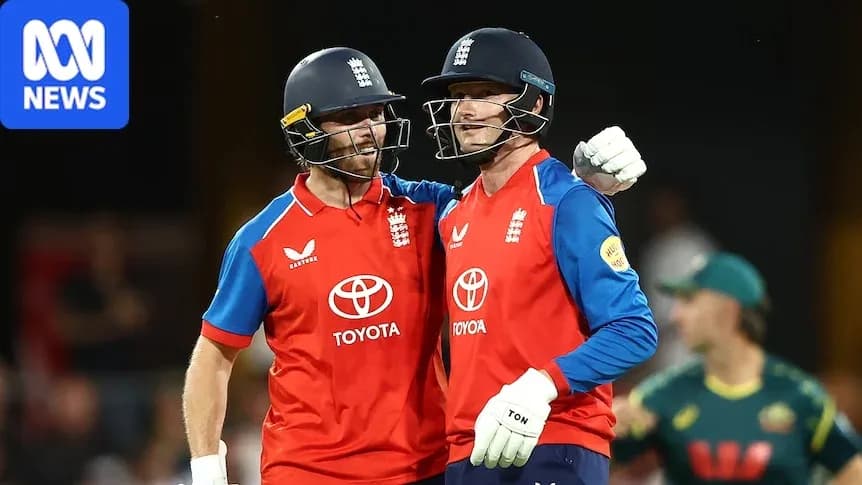
The defining moment of his spell came in the ninth over. England were rampant, powered by a 97-run stand, with Harry Brook in full, ruthless flow. Every error in length had been punished, every hint of width carved away. Australia needed a break, any break.
Chaudhary provided it with a ball that barely turned.
At 8.6, he pushed one through at 95.4kph, a fast legbreak outside off, asking Brook to manufacture something late. Brook, on 65 off just 28 balls with four fours and six sixes, tried to dab it fine to third man. Instead, he feathered a faint outside edge. Debutant wicketkeeper Sam Harper stayed calm, pouched it cleanly, and the finger went up.
Brook gone for 65. Stand broken. Chaudhary punched the air; Australia finally had the “big fish”.
That wicket didn’t come in isolation. The over had already been a mini-battle. Tom Banton, searching for rhythm, had moved leg-side to swing across the line and inside-edged to midwicket for a single. Before that, at 8.4, Chaudhary nailed a yorker at 93.8kph, only for Banton to just about dig it out. A toe-end flew past leg stump and trickled away to fine leg for four. Fortune favoured the batter, but the bowler was closing in.
He even tempted Australia into a failed review. At 8.3, a full ball drifting down leg brushed Banton’s pad as he looked to glance. Harper went up, Chaudhary joined late, Mitchell Marsh rolled the dice upstairs. Replays showed no inside edge; it was all pad and comfortably missing. Review lost. But the pattern was clear: the spinner was forcing decisions, forcing mistakes.
By the end of that over, though, the scoreboard told a different story from the mood. England still had runs, but Australia finally had a foothold.
Squeezing the middle, one dot at a time
From there, Chaudhary settled into a relentless, disciplined groove. He didn’t allow Sam Curran or Jordan Cox to dictate terms for long.
In the 10th over, he went at the stumps and into the pitch with subtle changes of pace. Curran tried to work him around but found no freebies. A length ball at 92.8kph was pushed to cover. A back-foot push took an inside edge towards midwicket. A full ball outside off was drilled straight to cover. Just when Curran looked set to break free, Chaudhary fired one full on leg at 91.2kph and was clipped through midwicket for two, then followed it with another full delivery that Jacks could only drive along the ground to long-off for a single.
The over finished with another full ball outside off, Curran driving but straight to the fielder. No boundary. No panic. “Another tidy over from Nikhil Chaudhary,” the numbers would say. The reality was sharper: he was quietly choking the innings.
He returned later to Curran and Cox with the same control. At 12.1, Curran jabbed through midwicket and should have had only one, but a fumble from Joel Davies allowed a second. Chaudhary shrugged it off, sliding the next ball in a fraction short outside off at 96.1kph, Curran cutting to deep point. Cox tried to break the shackles too, but a yorker-length ball at 93.5kph was jammed back, and a full delivery at 93.8kph could only be driven to long-off for a single.
The over ended with a googly outside off. Curran read it well enough to cut, but Marsh flung himself to the right at cover and cut off what looked a certain boundary. Again, the figures stayed lean. Again, the momentum stalled.
Curran falls, and the drops finally stop
Australia’s fielding had been ragged. Five chances had already gone down, each one a fresh wound. When Chaudhary came back in the 16th over, the game still had a wild, open feel. England, with wickets in hand, were eyeing a late surge.
He killed that idea with his first ball.
At 15.1, he tossed up a very full delivery outside off. Curran, on 21 off 20, went for the inside-out loft over cover, the kind of shot that can turn an over on its head. He didn’t get it. The timing went, the shape went, and the ball hung in the air long enough for Lachlan Shaw to sprint in from sweeper cover and take a clean, running catch.
Sam Curran gone for 21. Chaudhary again at the heart of it.
The dismissal carried extra weight because of everything that had come before it. Australia had shelled chances all evening; this one stuck. The bowler got his reward, the fielders finally backed him up, and a potential launchpad for England’s finish vanished in a single mis-hit.
Chaudhary didn’t let up after that. Liam Dawson tried to counter by using his feet, driving a full ball on middle and leg down to long-on. Before that, Dawson had been forced into nudges and pushes: a block back to the bowler, a driven single wide of cover, a brace steered past point when he made room to a slightly shorter ball. Cox, too, could only manage a single when he pushed a leg-break back down the pitch.
Every ball told the same story: England searching, Chaudhary dictating.
A spell that changed the mood
On a night dominated by big hitting and rapid scoring, Nikhil Chaudhary’s figures will read like a quiet interruption. They were anything but. He removed Harry Brook at full throttle. He prised out Sam Curran just as England eyed a final surge. Between those blows, he stitched together overs that denied rhythm, denied boundaries, and, crucially, denied belief.
In a format obsessed with sixes and strike-rates, it was a reminder that one calm, clever spell can still bend a game back towards the bowlers.