Kevin De Bruyne Returns to Manchester City Amidst Struggles
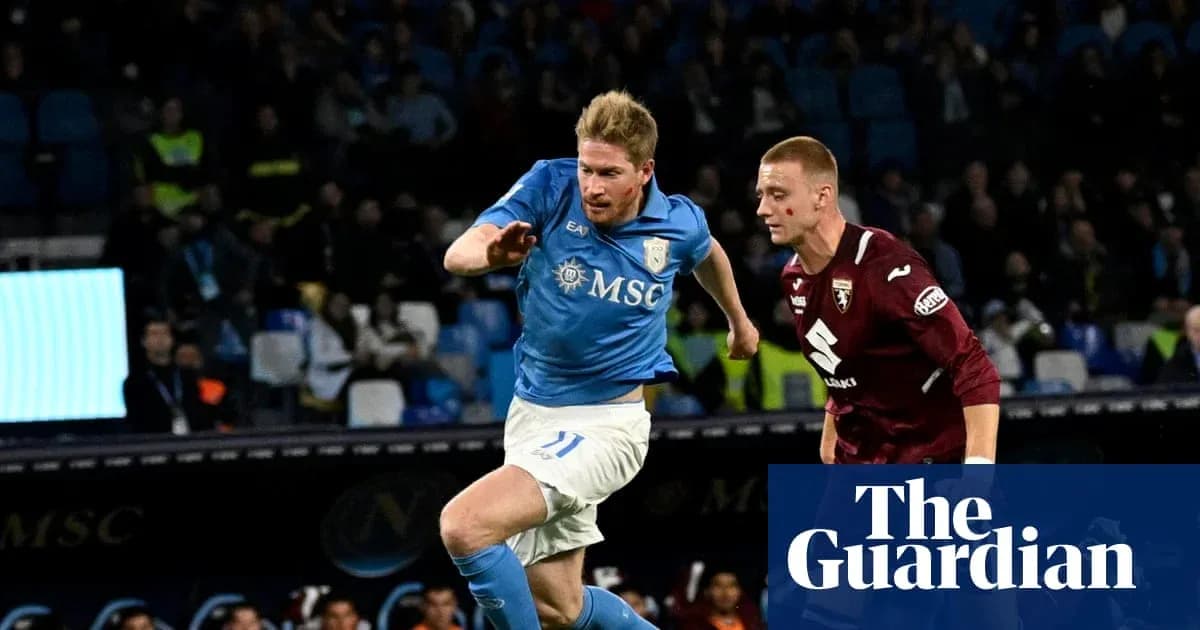
Kevin De Bruyne walks back into the Etihad on Tuesday not just as a visiting great, but as a living reminder of a standard Manchester City are suddenly struggling to reach.
For a decade under Pep Guardiola, City moved to his rhythm. Four consecutive Premier League titles, a Champions League, domestic cups stacked like trophies in a training-ground cabinet. At the heart of it all, the Belgian with the velvet touch and the iron will.
Now, as Enzo Maresca tries to steady a listing ship, De Bruyne returns from Serie A like a ghost of dominance past.
A legend returns to a club in flux
City’s European campaign under Maresca is ticking along nicely enough: three wins from four, job largely under control. At home, it is another story. One point from the last 12 available, goals drying up, a back line suddenly porous. The swagger has gone missing.
The Italian has responded by tinkering. New combinations, new shapes, new ideas. Nothing quite clicks.
Into that uncertainty steps De Bruyne, the player who left for nothing in the summer of 2025 having long since repaid the £55m City spent on him a decade earlier. His honours board is the stuff of club folklore: six Premier League titles, two FA Cups, five League Cups, a Club World Cup and that night in Istanbul when City finally conquered Europe, beating Inter.
He did not finish that final, limping off injured in Turkey, the body beginning to betray the mind. It became a theme of his later years in England. But the medals were already banked. The memories too.
Maresca knows better than most what City lost when De Bruyne walked away. He was Guardiola’s assistant for the 2023 treble season, working shoulder to shoulder with the Belgian.
“In the last 10 years, all the trophies the club achieved, Kevin was here and an important player, a fantastic player, a top guy, polite, fantastic,” Maresca said. “It was a pleasure to work with him.”
The old maestro, the new reality
The romantic pull of a return is strong, even if De Bruyne is no longer the unstoppable force he once was. His influence in Serie A has dimmed, his team-mates there struggling as much as he is. The aura, though, remains.
Jérémy Doku, who shared a dressing room with him for club and country, summed it up simply: “It’s fun to play with him. The quality he has is unbelievable, but we are all competitive so we all have to be on our best.”
At his peak, De Bruyne was Guardiola’s on‑field conductor and battering ram rolled into one. Two-footed, mercurial, ruthless. He could glide past a challenge, thread a pass that bent the laws of geometry, or just shift the ball half a yard and detonate from distance.
He explained it on Monday in his own way. “I play more based on the feeling I have and where the space is, where I can feel I’m the most dangerous.” Instinct, vision, conviction. City do not have another like him. Rayan Cherki may fancy himself as the heir, but has yet to prove it over any meaningful stretch.
For De Bruyne, the style he helped refine under Guardiola demanded bravery.
“You always have to have courage to play football, you cannot only go long and just play for duels,” he said. That was the creed of an era: take the ball, take the risk, take control.
Maresca’s search for a new heartbeat
City have known luxury in midfield. Yaya Touré once strode through games as if they belonged to him. David Silva dictated entire afternoons with a swivel of the hips and a five-yard pass. De Bruyne added power and penetration to that lineage.
Maresca, by contrast, is working without a ready-made talisman. His task is to build a collective that makes the most of the club’s expensive parts, to find chemistry where previously there was simply genius.
The balance is not there yet. Erling Haaland remains a devastating finisher, but even he cannot score off passes he never receives. The service from midfield and out wide has thinned, the supply lines kinked.
Against Fulham on Saturday, Maresca turned to youth and energy. Teenager Ayyoub Bouaddi started alongside Elliot Anderson, while £125m summer signing Enzo Fernández watched on from the bench.
Anderson was pushed higher, asked to inject the kind of thrust De Bruyne once provided almost by default. He lacks the Belgian’s technical refinement, but his volleyed effort hinted at a player willing to take responsibility. De Bruyne, watching on, might have approved.
“It is not complicated, it is just a matter of knowing each other,” Maresca said. “I need to understand who is the ideal one for this kind of game and different kind of games. I don’t think it is just midfielders, also we are trying with defensive players to find the right solution.
“It’s part of the process. It is like a restart after 10 years with the same manager, same faces, same words, same methods. It’s not easy to change all of a sudden.”
That is the challenge in a sentence. City are trying to reinvent themselves with the memory of perfection still fresh in everyone’s mind.
Living in the shadow of a golden trio
Cherki offers flashes of outrageous talent. Phil Foden still threatens, only intermittently now, to rediscover the form that once made him the club’s great homegrown hope. There are pieces, just not yet a picture.
De Bruyne never had that problem. He was part of a midfield axis that dominated both territory and time. Alongside Rodri and Ilkay Gündogan, he formed a trio that seemed to bend matches to their will. Defensive discipline, attacking invention, tempo control – all wrapped into three shirts.
Opponents walked into those games knowing the task bordered on impossible.
On Tuesday, the Etihad will rise for one of its greatest. The ovation will be for what he did, for what he represented, for the years when City felt untouchable.
The question lingering over Maresca’s City is simple: who, if anyone, will make the stadium feel like that again?