Pellegrino Matarazzo: From New Jersey to Real Sociedad Success
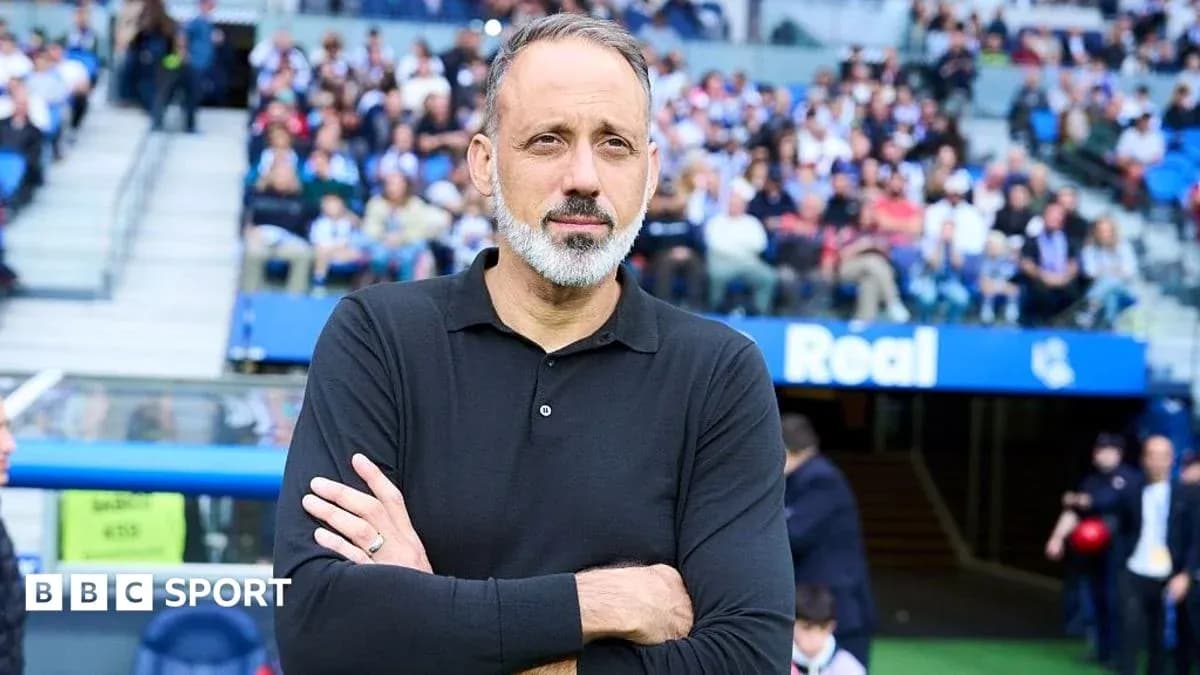
From a scruffy park in New Jersey to the podium in Seville with the Copa del Rey in his hands, Pellegrino Matarazzo has taken the long way round to the elite. Nothing about his rise to the Real Sociedad dugout looks neat on a CV. It makes perfect sense on a touchline.
He grew up in an Italian-American household where football wasn’t a hobby, it was inheritance. Sundays meant family, and family meant a ball at someone’s feet.
"My love for the game came from my family, from my dad, my uncles, the entire family with the Italian background loving the game," he says. With no MLS to follow, the TV in the Matarazzo home looked across the Atlantic, and the pull of southern Italy was strong. Napoli became the club of choice, the colours on the screen that matched the noise in the living room.
He played anywhere and everywhere. School teams. Club sides. Sundays in the park. Then college, where most careers in the United States tend to diverge away from the professional game. He went to Columbia University, studied applied mathematics, and on paper seemed destined for a very different life.
"It was just something I was good at," he shrugs now about the degree. It never lit him up the way the game did.
That curiosity he talks about – the itch that wouldn’t go away – eventually dragged him overseas. Germany, not Italy, became his proving ground. He chased a playing career in the lower leagues, driven and ambitious, but he hit a ceiling.
"I was always very ambitious but I never managed to play professional football above the third division at the time in Germany," he admits. At some point, the question came: go back to the United States and use the maths degree, or stay in football and find another way?
Coaching answered it for him. A chance to take his licences at a German club turned a crossroads into a clear road. On the training pitches, his analytical mind and his feel for the game finally met.
He worked his way up the hard way. At Hoffenheim he served under Julian Nagelsmann, part of a young, ideas-heavy staff that helped reshape the club’s identity. Stuttgart then handed him his first senior job. He took them up, then kept them up, stabilising the club in the Bundesliga. When Hoffenheim called him back as head coach, he steered them away from relegation danger and then into Europe.
By December 2025, Real Sociedad came knocking. A historic appointment followed: the first American to manage in La Liga, taking over a side stuck at the wrong end of the table and a club that prizes identity as much as results.
He arrived in San Sebastian with the team struggling near the bottom, but he didn’t start with the league table. He started with the people.
"The most important step was to really create the style of football and identity that fit both the people of Gipuzkoa and the team," he explains. He immersed himself in the Basque culture and saw traits he recognised.
"I really love the Basque culture. There are people that are very hardworking, intelligent, at the same time have the ability to remain humble and grounded despite success. Those are values that I also carry within me, which made it an easy transition."
Language came next. Spanish first, helped by his Italian, then the more daunting task of Basque. He admits that one is a challenge, but the effort matters in a region where belonging is everything.
On the pitch, one figure has become his standard-bearer. Mikel Oyarzabal, captain of the club and a key figure in Spain’s 2026 World Cup triumph, has become the embodiment of the culture Matarazzo wants in his dressing room.
"He embodies that ability to stay grounded despite success, to work hard," Matarazzo says. Oyarzabal is not the chest-thumping type. "He leads by example. He's not an emotional leader on the pitch, but he leads through clear communication and doing the work."
For a coach trying to shift habits and raise standards, that kind of captain is gold. It simplifies everything.
Together they have already delivered the kind of moment that binds a coach to a club. When Matarazzo arrived, he spoke of wanting to win a trophy. In April, in Seville, Real Sociedad lifted the Copa del Rey.
It was more than just silverware. The club had won the same competition in 2021, but that final had been played behind closed doors because of Covid restrictions. No roar. No sea of blue and white in the stands. No catharsis.
This time, everything was different. Fans travelled, filled the stadium, and lived every minute. "It was an amazing dynamic that started in January and that we just exponentially increased to the explosion in Seville to win the title," he recalls. "It was an unbelievable moment for everyone."
Their first trophy in five years, this one felt shared in full.
The achievement has not dulled his edge. With European football now on the calendar, Matarazzo is clear: success cannot become an excuse to relax.
"We always want more and it's always a maximum possibility. We want more than what we had last year and we want to do well in La Liga, in the cup, in the Europa League and in the Super Cup."
Right now, Sociedad sit fifth in La Liga, 14 points behind leaders Barcelona. Respectable, but hardly a position that satisfies his appetite. Another test comes on Thursday in London, a Europa League tie at Selhurst Park against Crystal Palace.
"We're expecting an emotional stadium with a team that has quality, despite their position in the Premier League table," he says. It is Thomas Frank’s first home game in charge, another variable to account for. "It's Thomas Frank's first home game in charge so we will see what he's changed and his direction. But we are ready and that's part of football."
Somewhere in all this – the Basque chants, the European nights, the tactical meetings in Spanish – there is still that kid from New Jersey, knocking a ball around in the park, dreaming without really knowing what he was dreaming of.
What would that boy think now?
"I think my younger self would be very curious as to what comes next, especially because it's never linear," Matarazzo reflects. "My wife, my son and I have also sacrificed a lot. But I also think he would be very proud."
Proud, yes. But curiosity still burns, and for Real Sociedad – and for every American coach watching from afar – the real question is what this unlikely journey dares to reach for next.