Formula 1 Drivers Discuss Penalty System in Innovative Rules Briefing
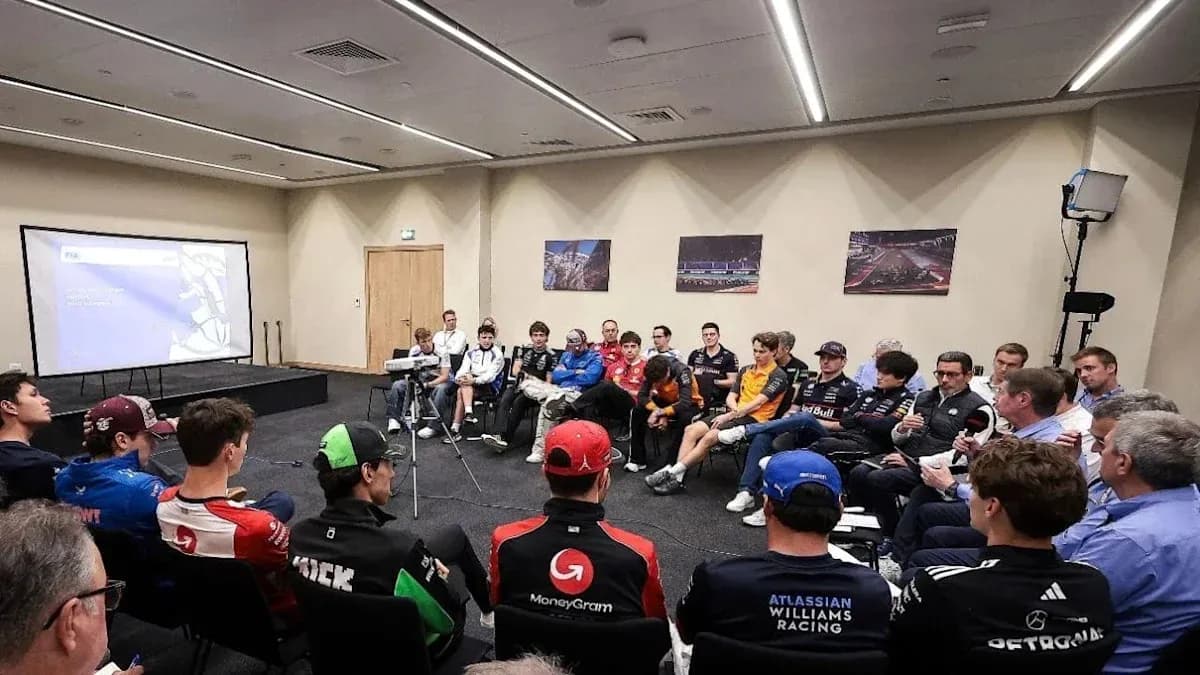
In a conference room in Qatar, Formula 1’s annual rules briefing looked less like a summit of the sport’s elite and more like a pub quiz gone high-tech.
On Thursday, November 26, the FIA sat the drivers down with the stewards, handed them a classroom-style quiz app on their phones and started rolling the footage. Incident after incident from the season flashed up on screen. Each time, the drivers had to tap in what penalty they would have given: five seconds, 10 seconds, drive-through… or nothing at all.
A grid of the world’s fastest racers, heads bowed over their phones, quietly voting on each other’s fate. Surreal, but very deliberate.
Drivers and stewards on the same wavelength – mostly
Kimi Antonelli, the newly crowned champion, walked out of the room satisfied. The Mercedes driver said that “most of us in the room were all aligned” with how the stewards had handled the clips, and that the exercise helped officials “to see how we see certain scenarios.”
Max Verstappen backed the idea as well. He called it “good to do that” because it allowed the stewards to hear “our voices of what we think a penalty should be,” as reported by The Race. For once, the people handing out the penalties and the ones receiving them were looking at the same screen, answering the same question.
Attendance told its own story. Fernando Alonso stayed away through illness. Lance Stroll simply chose not to show. Lewis Hamilton, who skipped the same meeting last year, made a point of turning up this time. The seven-time champion was blunt about it: “I didn’t go last year but I’m going to go tonight, yes.”
Inside, the format stayed simple. Each incident came with a menu of options on the drivers’ phones, ranging from different time penalties to no sanction at all. Some clips drew instant, unanimous agreement between drivers and stewards. Others split the room.
That split was the point.
A smarter way to hear what drivers really think
The FIA’s aim was clear: strip away the politics of the paddock and get honest answers. In front of cameras and rivals, a driver might bite his tongue rather than criticise a competitor’s punishment. Hidden behind anonymous taps on a screen, he can be brutally honest.
Antonelli felt the results exposed the grey areas that dominate modern race control. Some incidents, he said, are “so borderline that it’s so hard to establish who is at fault,” and in those cases the right outcome “just need to be a racing incident and no penalty.”
That sentiment had been simmering all week. The quiz only sharpened it.
Corner-cutting and the demand for quicker justice
Before the meeting, Oscar Piastri had already raised questions about the direction of the penalty system, pointing at decisions that felt overly harsh alongside others that, in his view, could have been tougher.
Nobody stormed out calling for a complete rewrite of the rulebook. There were no dramatic demands for sweeping changes next season. But one area sat under a brighter spotlight: track limits and corner-cutting, especially when drivers gain an advantage or complete an overtake off the circuit.
Antonelli wants that cleaned up fast and with less bureaucracy. His solution for drivers who cut a corner to make a pass is brutally simple: “Just tell the driver to drop the position straight away.” Give it back, move on. “If you give straight the position back is more fair as well,” he argued, rather than waiting for a time penalty that might arrive long after the moment has passed.
Another proposal floated in the room was a different type of sanction altogether – one that would strip a driver of a guaranteed position at the end of a race instead of slapping them with extra seconds. It would hit hard but avoid the confusion of time penalties reshuffling results long after the chequered flag.
Hamilton framed his return to the meeting as a chance “to help the racing be better and the ruling system I’m sure we can improve.” Verstappen, though, cut to the reality of power. The drivers can talk, suggest, and vote, but, as he put it, “of course they make their minds up and they decide what they’re going to do next year.”
That’s the catch with any feedback session in Formula 1. The quiz answers are logged, the debates are heard, the mood in the room is noted. The drivers only discover whether their anonymous taps meant anything when the next marginal call lands in the middle of a title fight and a steward reaches for the penalty menu.