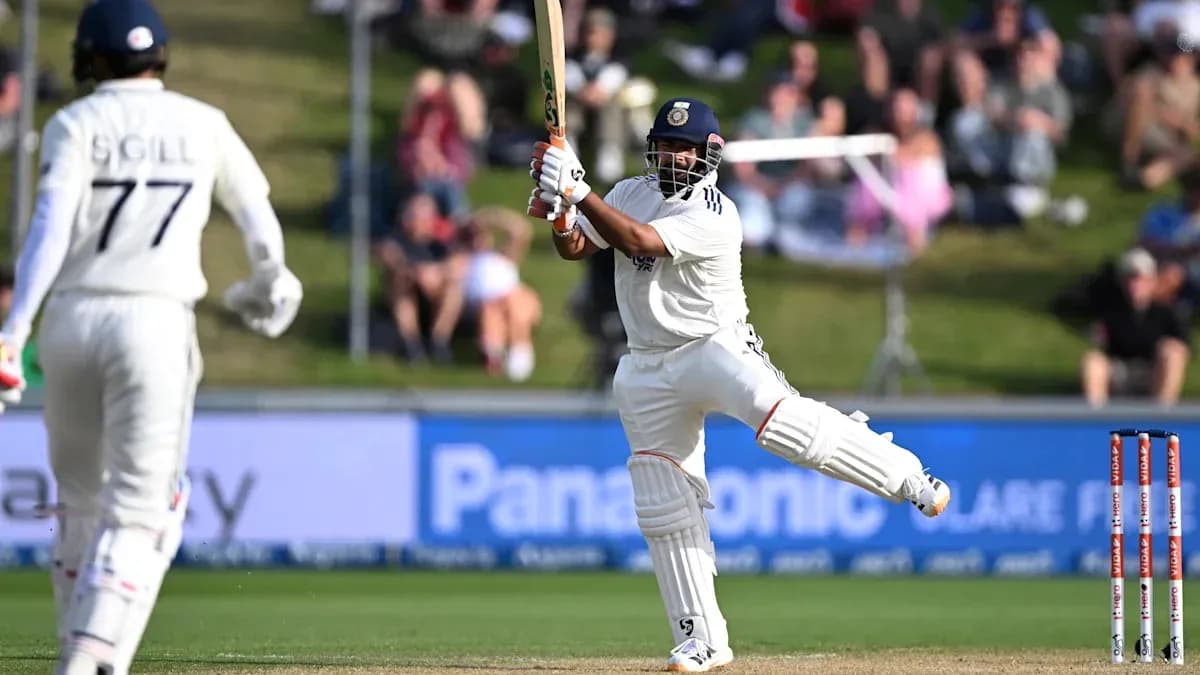
Rishabh Pant's Dominance Leads India to Commanding Position
WELLINGTON, New Zealand — Rishabh Pant walked off one ball before lunch with the Basin Reserve on its feet and New Zealand on its knees.
He had just been dismissed for a blistering 128, but by then the damage was done. India strode into the interval at 629-6 on the fourth morning, a towering lead of 261 over New Zealand’s 368 and with Dhruv Jurel still unbeaten on 32. The first test had tilted heavily, perhaps decisively, in India’s favor.
Pant’s counterattack, on his terms
Pant began the day on 52. He ended it — for New Zealand, at least — as the defining figure of the innings.
He took 135 balls to reach his ninth test century, carving nine fours and launching four sixes. The landmark arrived in a way that felt entirely in character: on 99, he skipped down and sent Glenn Phillips over the rope for six, leaping from nervous nineties to three figures in a single audacious blow.
This was his fourth test hundred since his return in 2024 from a horrific car accident. The story keeps adding new, defiant chapters.
New Zealand tried to crowd the boundary, posting five riders in the deep on Sunday morning. Pant treated it as an invitation rather than a deterrent. His wagon wheel told the tale: three sixes straight down the ground, others flogged behind square, most of his fours whipped and clubbed through the leg side. He even unfurled his trademark off-balance reverse sweep, a shot that looks wrong until the ball skids away to the rope.
He didn’t just survive the morning session. He drove it. India piled on 143 runs in 27 overs before lunch, the tempo almost entirely set by their wicketkeeper.
Partnerships that broke New Zealand
Pant’s stand with nightwatchman Anshul Kamboj underlined the relentlessness of India’s top order in this test.
They added 68 brisk runs in the first hour. Kamboj’s 38 was no mere token stay; he held his shape long enough to frustrate New Zealand before edging to Devon Conway off Phillips. By then, the lead and the pitch both looked heavier for the hosts.
That partnership extended a chain of substantial alliances that have defined India’s innings. K.L. Rahul put on 130 with Yashasvi Jaiswal for the first wicket. Rahul then added 165 with Devdutt Padikkal. For the third wicket, Rahul and captain Shubman Gill stacked on 91. Gill and Pant followed with a 100-run stand of their own.
Every time New Zealand thought they were close to the door, India slammed it shut with another partnership.
Jaiswal’s 85 on the opening exchanges set the tone, busy and assertive. Gill fell agonizingly short of a century, out for 98 two balls before stumps on the third day, but his near-hundred had already helped India surge past New Zealand’s total and into control.
Pant arrived in that context and simply accelerated the shift from control to dominance.
A brutal day for New Zealand’s bowlers
For New Zealand, the numbers made grim reading. Jacob Duffy bore the brunt, conceding 201 runs from his 33 overs. The figures reflected more than just volume; they captured the sense of being hunted.
Pant targeted the pace and spin alike, stepping out, sitting deep, improvising angles. Field changes became acts of damage limitation rather than genuine plans for dismissal.
By the time Pant finally fell, one ball before lunch, the immediate roar for his innings gave way quickly to a quieter realization: India’s lead had swelled into something that now demanded a monumental response.
New Zealand will have to find that response on a wearing fourth- and fifth-day surface, against an Indian attack that has watched its batters build a platform of rare authority.