Borussia Dortmund's Transformation Under Niko Kovač
Borussia Dortmund used to be shorthand for chaos and charisma. Jürgen Klopp on the touchline, yellow walls shaking, Bayern glancing nervously over their shoulder. That era is gone. What has replaced it is not as wild, not as romantic – but it might be far more ruthless.
The scars of recent near-misses still hang in the air at Signal Iduna Park. The title that slipped away against Mainz on the final day of 2023. The Champions League final in 2024, where Real Madrid did what Real Madrid do and punished every lapse. Dortmund came close to something era-defining twice, and twice they watched the trophy lifted by someone else.
Those blows triggered a reset.
Edin Terzić stepped aside after Wembley, and his assistant Nuri Şahin stepped up. It felt like a continuation of the club’s emotional, Dortmund-first identity: a favourite son, a link to the past, a familiar face in the dugout. It lasted seven months. Eleven defeats in 27 competitive games told their own story. Sentiment could not mask the slide.
Then came a name that split the fanbase in an instant: Niko Kovač. Former Bayern coach. Hard edges. No-frills football. A disciplinarian walking into a club that has long worn its chaos as a badge of honour. Many expected friction. Some expected outright rebellion.
Nearly two years on, the noise has faded. The numbers have not.
Seven goals conceded in the first nine games of this campaign is not just a neat statistic. It is a manifesto. Dortmund now defend with a seriousness that used to be reserved for their attacking fireworks. The change is not cosmetic; it runs through the squad’s body language, their reactions, their habits.
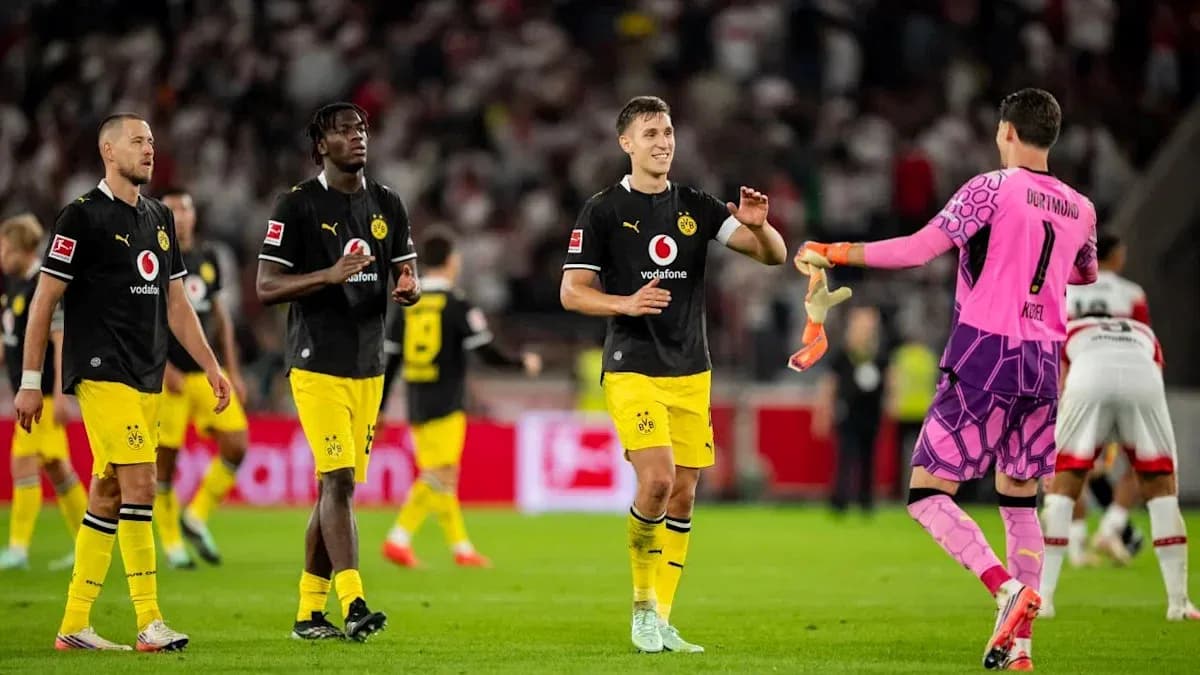
Concede, and the response is instant. Shoulders don’t drop, they square. The team steps forward. This is no longer a side that unravels when punched in the mouth. Twice at the Allianz Arena they fell behind. Twice they dragged themselves back, ripping a point from a stadium that has so often swallowed them whole. Late on, they camped in front of Jonas Urbig’s goal, wave after wave, but never losing their shape. The emotion remained, but it sat on top of a cold, organised core.
You can see the shift in the faces and profiles Kovač has leaned on.
Joane Gadou arrived in the summer and immediately added a different gear: raw pace, muscular power, and a defender’s brain wrapped in an attacker’s frame. He doesn’t just run; he hunts. Jobe Bellingham, walking a path lit by his brother’s rise, has grown into a role that attracted the attention of Thomas Tuchel – a testament not to hype, but to performances that carry weight at the highest level.
Then there is Maximilian Beier, perhaps the clearest symbol of this new Dortmund. Nine goals and five assists last season would usually buy a forward more freedom, more indulgence. Instead, Kovač has dropped him deeper, often as a wing-back. A goalscorer asked to graft in the shadows, to track runners, to press, to cover. Beier has accepted it. That choice – and his attitude towards it – says as much about this team as any heat map.
Self-sacrifice has become a principle, not a request.
Look at the running data and the picture sharpens. As the tenth round of fixtures looms, Daniel Svensson sits atop the domestic charts for intensive runs. The collective leads the league in duels won. This is not a side content to shuffle and contain; it is one that relishes the fight, then layers technical quality on top of that work.
Dortmund under Kovač will not stir the same romantic nostalgia as Klopp’s buccaneering vintage. They are something different: leaner, harder, less forgiving. And just when it looks like the path might clear, one familiar obstacle keeps looming into view – a club re-energised under a revived Vincent Kompany, ready to jab at Kovač’s ambitions all season long.