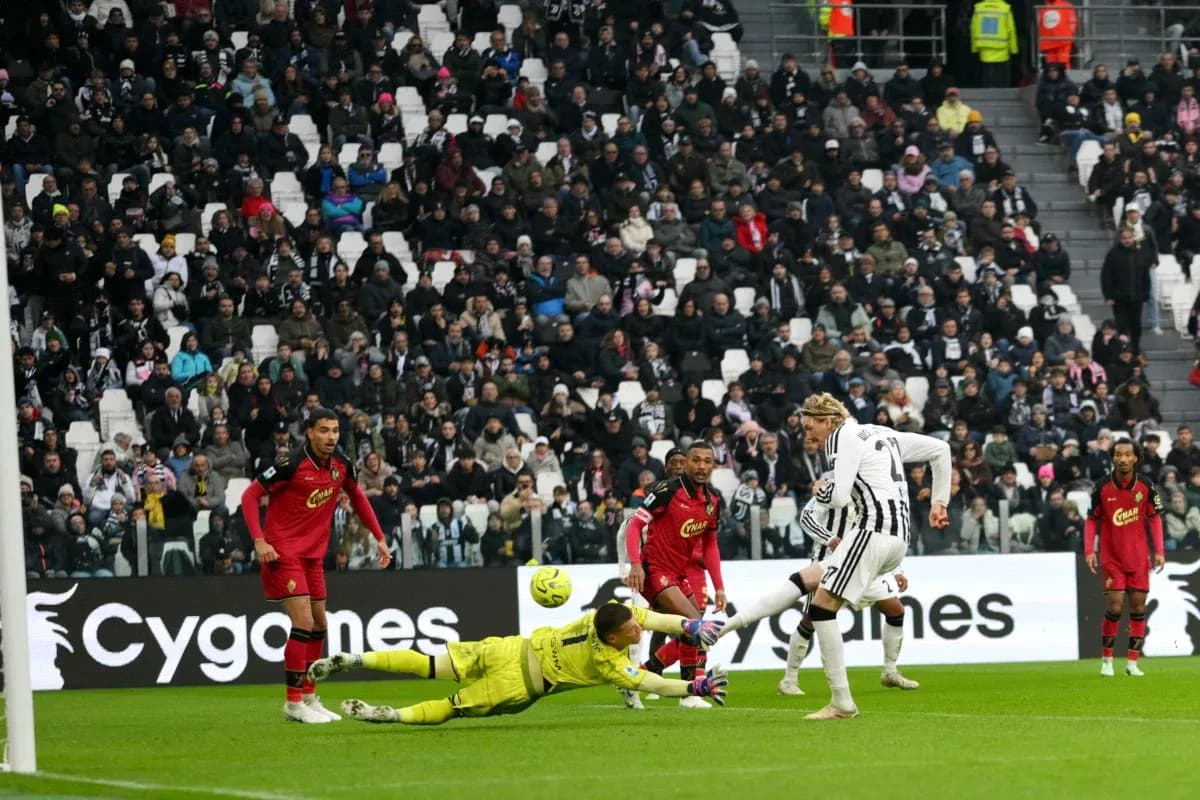
Juventus Dominates Venezia in Serie A Showdown
On a cold Turin afternoon at Allianz Stadium, Juventus delivered a statement performance that felt less like a routine home win and more like a tactical manifesto. In a Serie A campaign where consistency has often eluded them, a 4–0 dismantling of bottom‑placed Venezia in Regular Season - 12 crystallised the gap between a side with European ambitions and one fighting to stay afloat.
I. The Big Picture – A Season Compressed into Ninety Minutes
Heading into this game, Juventus sat 6th with 21 points from 12 matches. Their overall goal difference of 7 (19 scored, 12 conceded) told of a side more controlled than explosive, but with a clear upward curve: only 3 defeats and a home record that was quietly formidable. At home, they had played 6, winning 4, drawing 1 and losing just once, with 11 goals scored and only 4 conceded. This was already one of the league’s more reliable home fortresses.
Venezia arrived in Turin in a very different mood. Rock bottom in 20th with 6 points from 12 games, they carried a grim goal difference of -17, the product of 8 goals scored and 25 conceded overall. On their travels, the numbers were even more stark: 6 away matches, 0 wins, 0 draws, 6 defeats, with only 3 goals scored and 14 conceded. Their biggest away loss to date was 4–0; Juventus would go on to match that margin, underlining the structural gulf between the sides.
The match itself, finished in regular time at 4–0, became a distilled version of both teams’ seasonal DNA: Juventus’ late‑game ruthlessness and defensive control, Venezia’s fragility under sustained pressure and inability to manage momentum swings.
II. Tactical Voids – Who Was Missing, and What It Meant
Juventus came into this fixture with a sizeable absentee list that could have destabilised lesser squads. N. Gonzalez (calf injury), K. Grabara (knee injury), P. Kalulu (hamstring), M. Locatelli (knee), A. Milik (inactive), K. Thuram (knee) and K. Yildiz (foot) were all unavailable. On paper, that stripped Luciano Spalletti of rotation options across the spine – from goalkeeper to midfield creativity and forward depth.
Yet the starting XI in a 4‑2‑3‑1 looked coherent and balanced. Guglielmo Vicario anchored the side in goal, shielded by a back four of Zeki Çelik, Bremer, Lloyd Kelly and Jhon Lucumí Cabal. Douglas Luiz and Teun Koopmeiners formed a double pivot with both control and bite, while the line of three behind Randal Kolo Muani – Edon Zhegrova, Weston McKennie and Kerim-Sam Alajbegović – gave Juventus verticality and technical variety.
Venezia’s problems were compounded by their own absences. A. Adorante (hernia), T. Basic (muscle injury), T. Correia (thigh), B. Franjic (shoulder), P. Mazzocchi (muscle) and M. Sverko (hip) were all out, stripping Davide Nicola of depth in defence and wide areas. He stuck to his preferred 3‑5‑2: F. Stanković in goal behind a back three of R. Halhal, M. Moreno and Juan Jesus; a packed midfield of A. Hainaut, Kike Pérez, S. Sohm, Gianluca Busio and Ridgeciano Haps; and a front two of A. Adams and L. Lauberbach.
Disciplinary trends added another layer. Juventus’ season card profile shows yellow cards concentrated between 16–30 minutes (37.50%) and then again from 61–75 (18.75%), with a solitary red card coming deep into stoppage time between 91–105 minutes. Venezia, by contrast, spread their yellows more evenly but with a notable spike from 31–45 minutes at 30.43% and another cluster late on between 76–90 minutes at 17.39%. In a match where Juventus were likely to dominate territory, that volatility in Venezia’s timing of bookings always threatened to turn pressure into panic.
III. Key Matchups – Hunter vs Shield, and the Battle for Control
The “Hunter vs Shield” narrative here was less about a single prolific scorer and more about systems. Juventus’ attack has been defined by waves rather than one talisman: overall they average 1.6 goals per game, rising to 1.8 at home. Crucially, their goal timing is brutally skewed towards the closing stages. Overall, 36.84% of their goals arrive between 76–90 minutes, with another 26.32% between 61–75. This is a side that builds pressure and then finishes you late.
Venezia’s defensive profile is almost a mirror image of what you do not want against such an opponent. Overall, they concede 2.1 goals per game, rising to 2.3 away. Their most fragile windows are 16–30 minutes and 46–60 minutes, each accounting for 23.81% of goals conceded, with further soft spots between 61–75 (19.05%) and 76–90 (14.29%). Against a Juventus team that tends to surge after the break, those second‑half vulnerabilities were always likely to be exposed.
Within that structure, individual duels mattered. Zhegrova, one of Serie A’s leading assist providers with 3 so far, has been a high‑impact weapon despite starting only once in 10 appearances. His 16 key passes, 29 dribbles attempted with 16 successful, and 10 shots on target from 16 attempts underline a winger who can both create and finish. Up against a Venezia unit that had already suffered a 4–0 away defeat this season and often leaves its wing‑backs exposed, his presence on the right side of Juventus’ 4‑2‑3‑1 was a natural pressure point.
On the other side of the ball, Kike Pérez embodied Venezia’s “Engine Room.” With 606 passes at 85% accuracy, 25 key passes, 30 tackles and 3 successful blocks, he is both their organiser and their disruptor. His disciplinary record – 3 yellow cards – and heavy duel load (125 duels, 56 won) show a midfielder who lives on the edge to keep his team competitive. Alongside S. Sohm, another with 3 yellow cards and a physically imposing profile, Venezia’s plan was clear: compress the central lanes, slow Douglas Luiz and Koopmeiners, and deny clean service into Kolo Muani and Zhegrova.
But structurally, Juventus’ double pivot was built to outnumber Venezia between the lines. Douglas Luiz’s metronomic passing and Koopmeiners’ ability to step into advanced pockets allowed McKennie to roam and Alajbegović to attack half‑spaces. With Çelik and Cabal pushing from full‑back, Venezia’s 3‑5‑2 was constantly stretched horizontally, forcing Kike Pérez and Sohm into wider defensive zones where their tackling could not compensate for the numerical overloads.
IV. Statistical Prognosis – Why a Heavy Home Win Always Loomed
The underlying numbers made a dominant Juventus performance more likely than not. At home, they had already kept 4 clean sheets in 6 matches, conceding just 4 goals at an average of 0.7 per game. Overall, they had 6 clean sheets in 12 fixtures, failing to score only twice all season. Venezia, in stark contrast, had managed just 1 clean sheet in total and had failed to score in 7 of their 12 matches, including 4 times away. Their away scoring average of 0.5 goals per game was always going to struggle against a Juventus defence that concedes only 1.0 per match overall.
Goal‑timing intersections were decisive. Juventus’ late‑game surge – with 63.16% of their goals coming between 61–90 minutes – crashed directly into a Venezia side that concedes 52.39% of its goals in that same 61–90 window. Once the home side established territorial control, the probability curve tilted sharply: tired legs in Venezia’s back three, wing‑backs pinned deep, and a midfield forced into last‑ditch challenges.
Even set‑piece psychology favoured Juventus. They had converted their only penalty of the season, while Venezia had taken one and missed it, a 100.00% miss rate that subtly underlines the difference in composure at critical moments.
In the end, the 4–0 scoreline did not feel inflated. It was the logical outcome of a clash between a well‑tooled, late‑surging Juventus machine and a Venezia side whose structural weaknesses, disciplinary strain and away‑day frailty were all ruthlessly exposed under the Turin lights.