Maresca's Reset: City Seek Balance Against Fulham's Challenge
The Etihad felt different. Not hostile, not anxious, but sharpened. Three straight league defeats will do that to a club that has grown used to cruising through autumn.
Enzo Maresca walked out into the chill November air knowing this was more than just another early kick-off. This was a stress test of his ideas, his reshaped midfield and his own authority, against a Fulham side that have quietly forgotten how to lose.
On the pitch, the tone was set early.
Fulham, in red from head to toe, took the first touch. Within two minutes Gianluigi Donnarumma, under scrutiny after recent errors, had already calmed a few nerves with a couple of clean, uncomplicated touches from back-passes. No drama. Just what he needed.
At the other end, Bernd Leno went long towards Rodrigo Muniz, Fulham trying to turn City around early. The ball was worked wide to Kenny Tete, his cross collected confidently by Donnarumma. City then tried to settle into their patterns, working the ball across their defensive third, drawing Fulham’s press, looking for that familiar passing lane that opens the whole pitch.
It wasn’t all smooth. It rarely is when a side is trying to play their way out under pressure after a bad run.
Alex Iwobi, booked inside six minutes for hauling back Elliot Anderson as the City midfielder spun away, set the tone for Fulham’s aggression. The visitors snapped into tackles, pressed high and tried to disrupt City’s rhythm before it began.
New Faces, Same Demands
Maresca had promised balance, not revolution, and his team sheet reflected that. Three changes from the defeat at Nottingham Forest: Nico O’Reilly, Ayyoub Bouaddi and Phil Foden came in; Josko Gvardiol, Enzo Fernandez and Rayan Cherki dropped to the bench.
It was a clear message. The coach wasn’t ripping up his blueprint. He was adjusting the angles.
Bouaddi, handed a start in midfield, was asked to bring calm beside the energetic Anderson. Early on, he did exactly that, nicking the ball off Tete in midfield on 12 minutes and immediately turning City upfield. It was the sort of intervention Maresca wants to build a structure around: win it, play forward, keep the tempo high.
City’s shape had a slightly experimental feel. Donnarumma behind a back line that included Abdukodir Khusanov and Marc Guehi, both selected despite recent injury concerns. Ahead of them, O’Reilly and Anderson provided legs and passing options, Bouaddi the metronome, with Iliman Ndiaye, Foden and Jeremy Doku buzzing around Erling Haaland.
The intent was obvious: keep attacking as before, but tighten the screws when the ball is lost. Maresca had spelled it out in his pre-match briefing.
“The same midfield that won seven games in a row is the same that lost three games in a row,” he said. “The idea is to continue to attack in the same way, creating chances, but trying to create a balance when we defend. We are conceding too many goals. Most of them are avoidable. So we need to avoid mistakes and try to deal with it when it happens.”
This was the first real examination of that promise.
Fulham Refuse to Play the Victim
Fulham arrived with history weighing heavily against them. They have not beaten City since 2009 and had lost 20 consecutive meetings in all competitions going back to 2012. Those numbers usually crush belief before a ball is kicked.
Alvaro Arbeloa has no interest in that kind of fatalism.
The Fulham head coach came north with his side unbeaten in four and talking about City with something close to admiration rather than fear. “They have the chances. You can see the quality of the players, how they want to play. They are very, very aggressive when they lose the ball, so for me they are performing really, really well,” he said. For him, the three defeats did not rewrite City’s status: “They’re still one of the best teams in the world.”
His team selection backed that up. No parked bus, no mass rotation. Kenny Tete, Ryan Sessegnon and Muniz came in for Timothy Castagne, Antonee Robinson and Gonzalo Garcia, but the structure remained front-footed.
Fulham’s XI: Leno; Tete, Calvin Bassey, David Affengruber, Sessegnon; Tyrese Francois Charles, Sander Berge, Iwobi; Andreas King, Oscar Bobb, Muniz. The bench carried options and experience: Kaiser, Cuenca, García, Palacios, Cairney, Larsson, Angel, Castagne, Robinson.
They started like a side determined to ask questions. Berge’s early cross forced a corner after a mix-up between Ndiaye and Ruben Dias. From the resulting Iwobi inswinger, Donnarumma again imposed himself, coming through bodies to claim.
Then came City’s first real flash.
Haaland Hunted, Fulham Hold
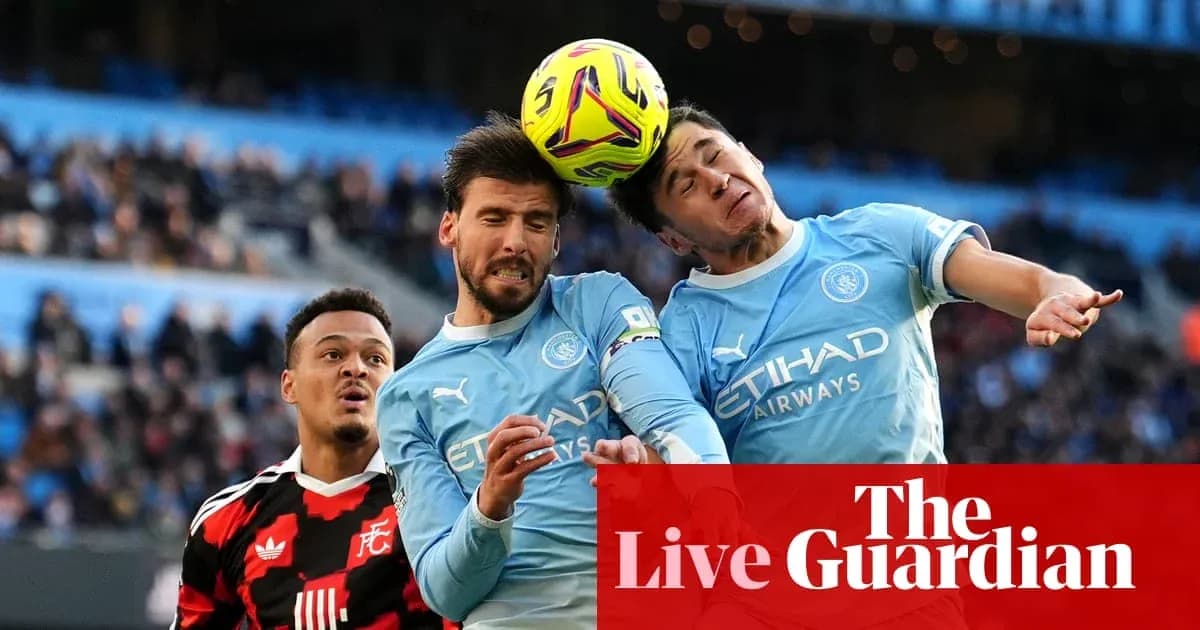
On eight minutes, Doku finally found a yard. The Belgian winger, who had been crowded out a couple of times in the opening exchanges, drifted into space and whipped a cross to the far post. Haaland rose, cushioned a header back across goal, and Affengruber launched himself to nod the ball clear. Seconds earlier, the Fulham defender had thrown himself in front of a Haaland shot.
That was the pattern: City probing, Fulham defending with conviction, no sense of inferiority.
O’Reilly tried to change the script on 10 minutes, his shot deflected behind by Affengruber. The resulting corner came to nothing, but City’s intent was rising. Doku, Haaland, Foden – all starting to take up more dangerous positions between the lines.
Fulham, though, refused to wilt. They broke when they could, used Muniz as an outlet, and kept their back four compact. Leno, unhurried, went long when required, trusting his forwards to fight for scraps.
And in midfield, Iwobi walked a tightrope after his early booking, but he never hid. He demanded the ball, hit long diagonals, and tried to release Tete and Sessegnon whenever City’s press left a gap.
Maresca Under the Spotlight
Away from the technical details, the day carried a heavier mood for City. This wasn’t just about three points; it was about halting a narrative.
The club’s off-field uncertainty has swirled into the conversation around every performance. Maresca knows he cannot control any of that. What he can control is the way his team respond to setbacks, the way they defend their own penalty area, the way they carry themselves when confidence dips.
“I was not thinking we were doing everything well when we were winning games,” he said. “I’m not thinking we did everything wrong when we lost games. There are things we need to do better and no doubt we will do better.”
The Etihad crowd, ushered in by a guard of honour formed by “Once A Blue” greats such as Mick McCarthy, Peter Barnes, Paul Lake and Davids White and Brightwell, understood the stakes. They wanted a statement. Any win would do, but a dominant one would change the tone of the season.
The team sheet underlined that urgency. Donnarumma in goal; Khusanov and Guehi trusted despite recent fitness doubts; Dias anchoring. In front of them, Anderson and Bouaddi asked to give City’s midfield both bite and composure. Foden, Doku and Ndiaye tasked with feeding Haaland and pinning Fulham back.
On the bench, Maresca kept serious firepower in reserve: Rulli, Kovacic, Cherki, Fernandez, Reis, Gvardiol, Allan, Samba, Lewis. Options everywhere, but also a clear hierarchy. He wanted this particular XI to answer the question.
Fulham’s Belief, City’s Burden
Arbeloa, for his part, arrived with his own small storm to manage. Calvin Bassey, one of his captains and a cornerstone of this Fulham side, has been linked with Manchester United. The coach batted away the noise.
“He is one of my captains,” Arbeloa said. “I think he is one of the best centre backs in the world, so it’s normal if there are so many teams that wants Calvin. I’m not worried about that because I am really happy with Calvin. I think Calvin is really happy here. He is so important for us. He is one of our leaders.”
Bassey played like it, marshalling the back line, tracking Haaland, and stepping out when needed. For a club that hasn’t beaten City in 15 years, that kind of conviction matters.
Fulham’s broader context underlined the challenge. Reserve goalkeeper Benjamin Lecomte is out for the season with a ruptured Achilles. Tom Cairney is nursing a knee problem. Emile Smith-Rowe has a hip issue and was not expected to feature. Yet the squad has found a way to stay unbeaten across four games, including a comeback draw against Newcastle.
They came to Manchester not as tourists, but as a side sensing a rare opportunity: a giant with a wobble, a fortress with a few cracks.
A Season Poised on a Knife Edge
As the first quarter of an hour ticked by, the story of the afternoon began to form. City dominating territory, Fulham organised and stubborn, both managers watching every turnover like a referendum on their ideas.
Maresca has vowed to keep attacking. Arbeloa has insisted his team will respect, but not fear, anyone. Between those two stances lies the question that will shape both seasons.
Can City rediscover their ruthless edge without losing the ball security that once made them untouchable? Or is this the moment when a familiar fixture, one-sided for so long, starts to tilt in a new direction?