Newcastle vs Arsenal: A 2-2 Draw Reflecting Contrasting Seasons
The lights have gone out at St James’ Park with the scoreboard locked at 2-2, but this was a draw that said as much about Newcastle’s stubborn reinvention as it did about Arsenal’s title credentials.
I. The Big Picture – contrasting seasons, shared formation
In the chill of a November evening, 13th-placed Newcastle met league leaders Arsenal in a clash that pitted necessity against refinement. Both sides lined up in a 4-2-3-1, mirroring shapes but not trajectories.
Heading into this game, Newcastle’s season had been defined by volatility: 3 wins, 4 draws and 4 defeats in 11 matches, with 15 goals scored and 18 conceded overall. A goal difference of -3 underlined a side still searching for balance. At home, they had only 1 win from 6, with 8 goals scored and 9 conceded – an average of 1.3 goals for and 1.5 against at St James’ Park.
Arsenal arrived as the division’s standard-setters. Top of the table with 28 points from 11, they had 9 wins, 1 draw and just 1 defeat, with 17 goals scored and 7 conceded overall – a goal difference of +10. On their travels, they had 4 wins, 1 draw and 1 defeat, scoring 7 and conceding 5, averaging 1.2 goals for and 0.8 against away from home. This was the armour Newcastle had to pierce.
II. Tactical Voids – absences shaping the game
The team sheets told their own story of compromise.
For Newcastle, M. Jaissle had to do without E. Jaouen and the powerful presence of Joelinton, both sidelined by muscle injuries. Their absence stripped Newcastle of a physical, ball-carrying presence between the lines and a pressing reference in midfield. It placed greater responsibility on L. Miley and Sean Steur as the double pivot, and on J. Willock to break lines from the number 10 space.
Arsenal’s absences were arguably more high-profile. Mikel Arteta was missing B. Saka through a thigh injury, while M. Zubimendi’s muscle problem removed a deep-lying metronome from the base of midfield. M. Dowman was also unavailable through suspension after a red card. Without Saka, Arsenal’s right-sided threat had to be reconstructed, and the creative load redistributed across N. Madueke, M. Ødegaard and E. Eze.
Disciplinary trends added another layer. Newcastle’s season-long yellow card profile showed a propensity for late-game volatility: 25.81% of their yellows had come between 76-90 minutes, with another 19.35% in added time from 91-105 minutes. Their only red card of the league campaign had also arrived in added time, in that 91-105 minute window. Arsenal, by contrast, had spread their cautions more evenly, with a notable 35.29% of their yellows also arriving between 91-105 minutes. This match was always likely to become more ragged and combustible as fatigue set in.
III. Key Matchups – Hunter vs Shield, and the Engine Room
Hunter vs Shield
For Newcastle, the obvious attacking reference remained H. Barnes. Heading into this fixture, he had 3 goals and 2 assists in the league, from 11 appearances and 976 minutes. His 20 shots, with 9 on target, and 15 key passes marked him as Newcastle’s primary end-product merchant from the left half-space. Barnes is not just a finisher; he had also blocked 5 shots and made 8 tackles, an all-action profile that fits Jaissle’s requirement for wide players to track back.
His duel was primarily with J. Timber and E. Konsa on Arsenal’s right side, and with the collective of a defence that had conceded only 7 goals overall all season. Away from home, Arsenal had allowed just 5 goals in 6 games. The “shield” Barnes faced was built on structure rather than last-ditch heroics.
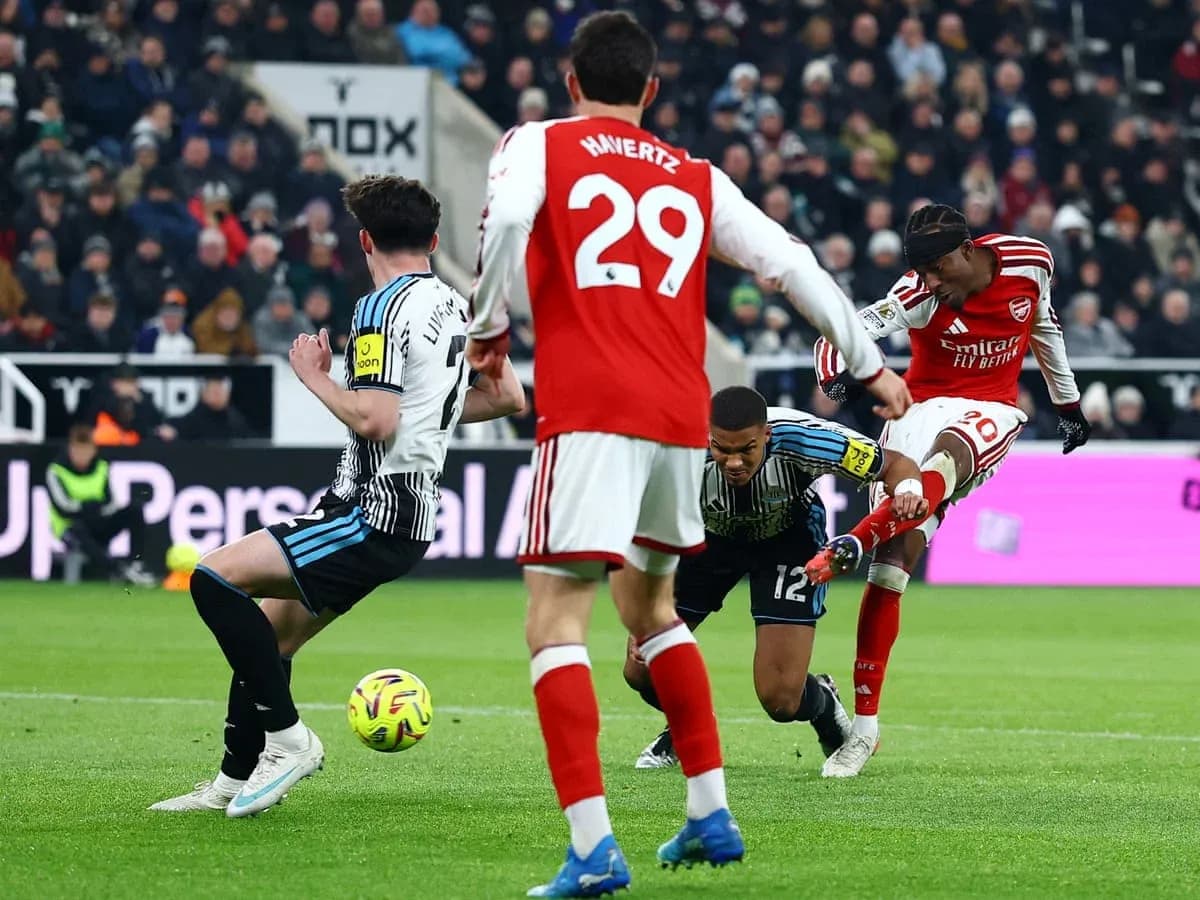
On the other side, Arsenal’s most direct “hunter” was K. Havertz. He also came into this match with 3 league goals and 1 assist, from 11 appearances and 825 minutes. With 15 shots and 8 on target, he offered a penalty-box presence and aerial threat that tested Newcastle’s central pairing of M. Thiaw and D. Burn. Newcastle’s overall record of 18 goals conceded, with 9 at home, suggested vulnerability when forced to defend sustained pressure.
Engine Room – where the game’s rhythm lived
The midfield duel was defined by two very different organisers.
For Arsenal, D. Rice has been the league’s standout creator from deep, with 5 assists and a towering 7.35 average rating across 11 appearances. His 733 passes with 18 key passes, 13 tackles, 5 blocks and 10 interceptions paint the picture of a complete controller: the man who starts attacks, stops counters, and dictates tempo. Rice’s positioning alongside Bruno Guimarães – here in Arsenal colours – formed a double pivot capable of both protecting the back four and feeding the trio of Madueke, Ødegaard and Eze.
Opposite them, Newcastle’s double pivot of L. Miley and Sean Steur had a different brief: disrupt, screen and spring transitions quickly into the feet of Willock, Barnes and J. Murphy, with W. Osula stretching the line. Without Joelinton’s ball-carrying, Newcastle were more reliant on quick vertical passes and second-ball wins.
IV. Structural Themes – risk, reward, and psychological edges
Newcastle’s season numbers hinted at a side living on the margins. They had failed to score in 2 home matches but had also kept 2 clean sheets away from home. Their average of 1.4 goals scored overall and 1.6 conceded underscored a thin line between resilience and collapse. The psychological scar of a missed penalty this season – 1 taken, 0 scored, 1 missed, a 0% conversion rate – also loomed over any spot-kick scenario. In a tight game against the league leaders, that kind of detail can weigh heavily.
Arsenal, by contrast, had been ruthlessly efficient from the spot: 1 penalty awarded, 1 scored, a 100% record. It was emblematic of a team whose margins had largely fallen their way.
Both sides have leaned heavily into the 4-2-3-1 this campaign – Newcastle and Arsenal had each used it in all 11 league matches. That continuity showed in the automatisms: overlapping full-backs (L. Hall and A. Dedić for Newcastle; R. Calafiori and Timber for Arsenal), inverted movements from the wide tens, and a single striker asked to both press and link.
V. Statistical Prognosis – what the numbers say about the draw
Following this result, the underlying patterns still hold. Arsenal remain the more complete, controlled side: 17 goals for and 7 against overall, with 7 clean sheets and only 1 match all season in which they failed to score. Newcastle continue to live in the grey zone between mid-table comfort and danger, with their -3 goal difference reflecting both attacking promise and defensive fragility.
In xG terms – though not explicitly given here – the profile suggests Arsenal typically generate slightly more than they concede, with a tight, low-variance defensive structure, especially away. Newcastle, with higher averages conceded than scored at home, are more chaotic by nature.
This 2-2 at St James’ Park, then, felt like the meeting point of those identities: Arsenal’s polished control against Newcastle’s emotional, late-swinging volatility. Barnes and Havertz embodied the threat; Rice and the Newcastle pivot embodied the struggle for control. On another night, a penalty, a late card, or a single duel might have tipped it. Instead, the story of the evening was balance – an uneasy, enthralling balance between a team chasing the title and another still defining what it wants to be.