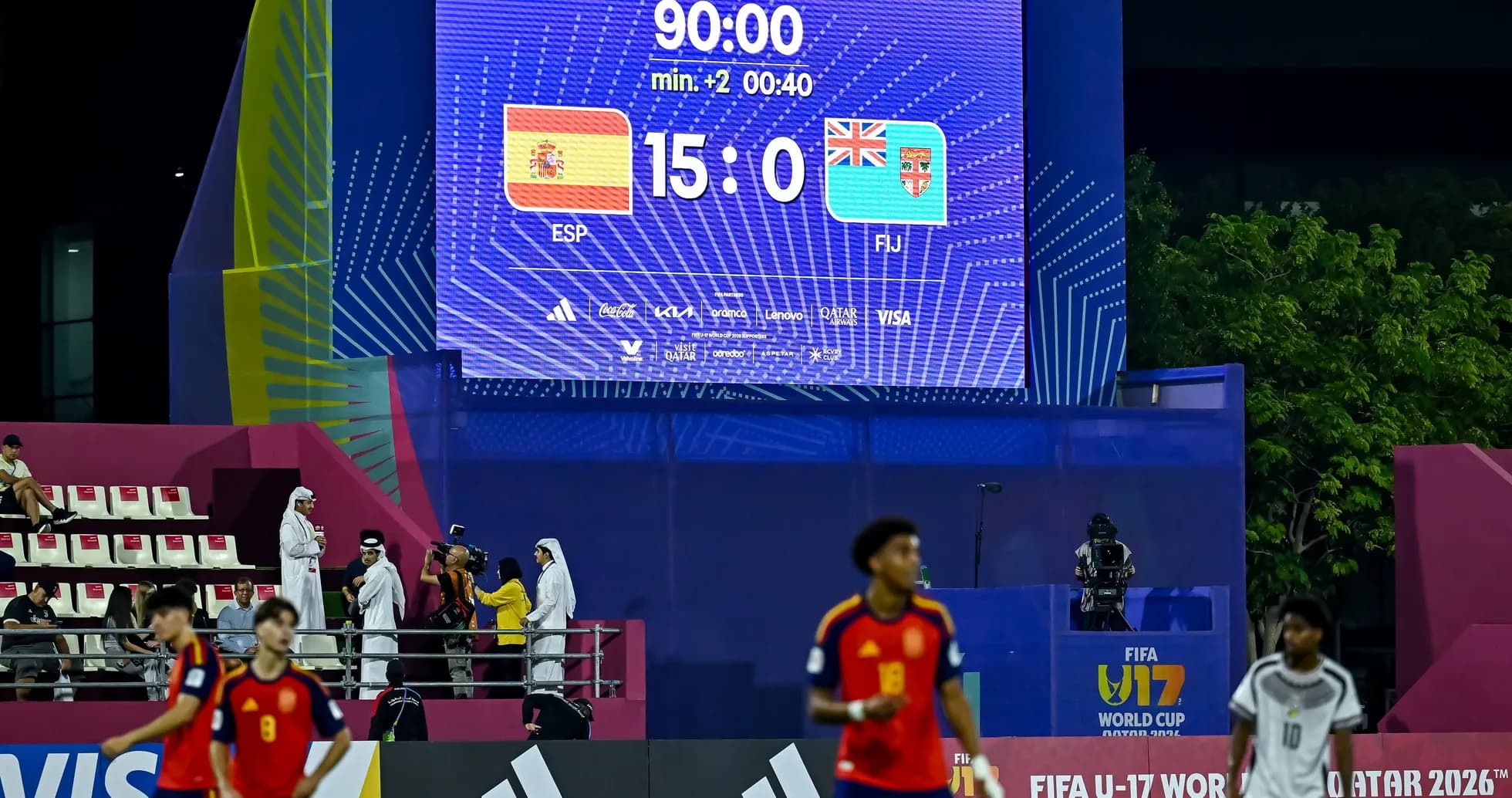
Spain 15-0 Fiji: A Historic U-17 World Cup Victory
Spain did not just beat Fiji in Qatar. They tore up the script for what an U-17 World Cup group game is supposed to look like.
On a warm November 23 evening, the European heavyweights ran riot, dismantling Fiji 15-0 in Group H to record the second-biggest win in FIFA U-17 World Cup history. Three hat-tricks, a five-goal haul, and a scoreline that will sit in the record books – and in Fijian football’s memory – for a long time.
A Blitz from the First Whistle
From kick-off, this was a mismatch laid bare.
Spain pressed high, recycled possession with ease and flooded forward in waves. Fiji barely had time to breathe, let alone build. By half-time, the scoreboard at Qatar’s Aspire Zone already read 9-0. The contest had ended long before the interval; only the margin remained in question.
Rafa Cruz set the tone and never let up. He completed his hat-trick inside 21 minutes and kept going, finishing with five goals in a personal masterclass of movement and finishing. Every run he made seemed to find space, every touch carried menace.
Roberto Tomas and Guillermo Trujillano joined the scoring frenzy, each completing hat-tricks of their own. Both converted from the penalty spot to seal their trebles, piling on the punishment as Fiji’s defence disintegrated under relentless pressure.
The goals kept coming from all angles. Marco Company got in on the act. Substitute Yeremaiah Ramos added his name to the sheet. Jorge Dominguez Lituba struck twice to round off a European rout that felt historic even before the final whistle.
Because it was.
History Rewritten
Spain have a long tradition of technical excellence at youth level, but this result sits in a category of its own.
The 15-0 victory is Spain’s biggest-ever win at a FIFA U-17 World Cup, eclipsing their 13-0 demolition of New Zealand back in 1997. Across the tournament’s entire history, only one result stands above it: Morocco’s astonishing 16-0 thrashing of New Caledonia in the 2025 edition.
This was not just a routine group-stage win. It was a statement of depth, ruthlessness and attacking clarity, the kind of performance that forces the rest of the field to sit up and take notice.
For Fiji, it told a very different story.
Fiji’s Defensive Crisis Laid Bare
The Junior Bula Boys arrived in Qatar hoping that a second consecutive World Cup appearance might signal steady progress. Instead, Group H has exposed the scale of the work still to be done.
After a 6-0 defeat to Morocco on November 20, this 15-0 collapse means Fiji have conceded 21 goals in just two group matches, without scoring once. That figure already surpasses the 20 they let in across their entire 2025 campaign, when they fell 6-0 to Tunisia, 7-0 to Belgium and 7-0 to Argentina.
Five World Cup matches. Forty-one goals conceded. None scored.
These are not just bad days at the office; they are brutal markers of a gap in physicality, organisation and tournament experience at this level.
The warning signs had been flashing long before kick-off in Qatar. During their final warm-up camp in the United Arab Emirates, Fiji lost three straight friendlies: 2-0 to Vietnam, 5-1 to Tajikistan and 9-0 to Venezuela. Since November 9, they have now shipped 37 goals in five games.
This is no short-term blip. It is a structural alarm.
Disruption Off the Pitch, Damage On It
Fiji’s preparations were anything but smooth.
Senior national team head coach Stephane Auvray was drafted in to lead the U-17 side at short notice after Sunil Kumar departed for PNG Hekari FC. That kind of late change is disruptive at any level; in youth football, where trust and continuity are vital, it can be devastating.
Even with the return of captain Maikah Dau and several players carrying experience from last year’s tournament, Fiji have looked disjointed and overwhelmed. The heavy defeats underline how far their youth development pathways still have to go if they are to compete with the game’s emerging powers, let alone its traditional giants.
The players are young. The scars, though, can linger unless the response is measured and long-term.
One Game Left, One Simple Target
Fiji now face China PR on Thursday, November 26, again at the Aspire Zone. Knockout qualification is gone. The mathematics no longer matter.
What does matter is pride.
Auvray’s squad must find a way to tighten up defensively, to compete in duels, to stay switched on for 90 minutes. Above all, they are chasing something that has eluded them across two World Cups: a single, cathartic goal.
Forty-one conceded, none scored. That is the stark ledger they carry into their final Group H match.
Spain leave this fixture with history in their pocket and momentum on their side. Fiji leave it with questions, and one last chance in Qatar to change the only number that truly haunts them: zero.