Harbhajan Singh Urges ICC and BCCI to Address Indo-Pak Rivalry Issues
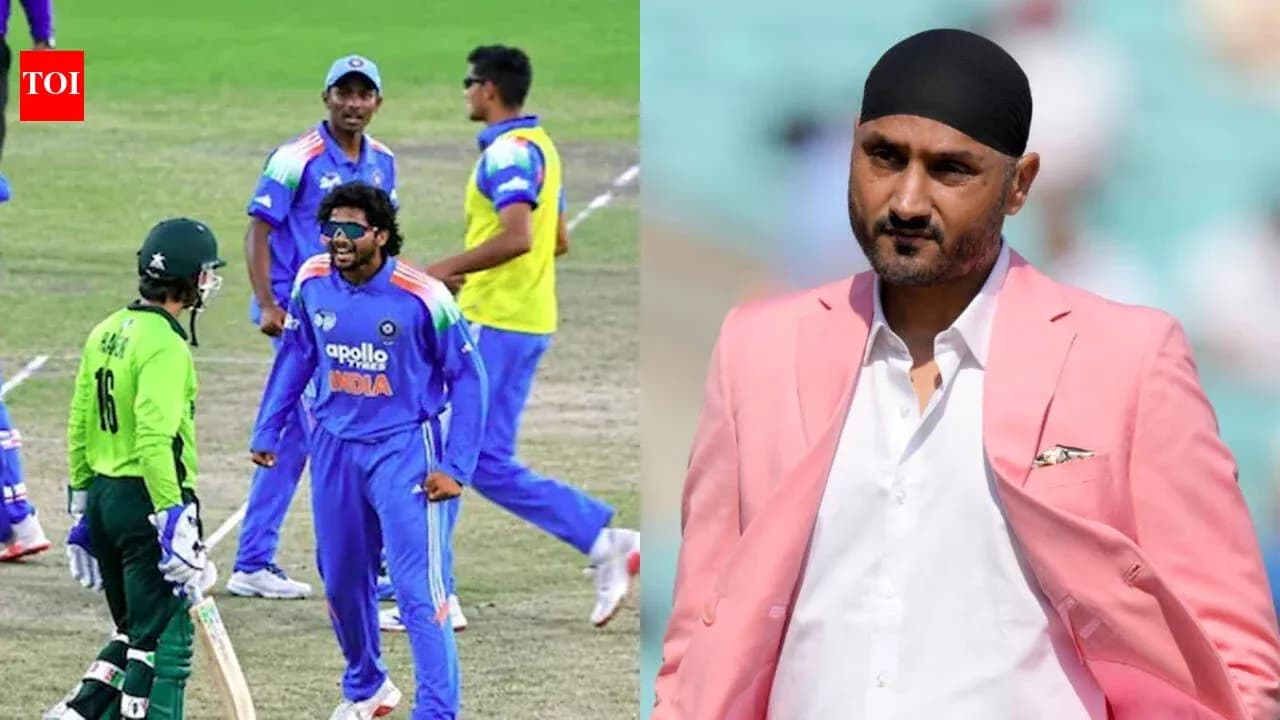
Harbhajan Singh has added his voice to growing unease over the escalating on-field antics in India-Pakistan clashes, warning that the spectacle is tipping from passionate rivalry into something “shameful” and urging the ICC and BCCI to act before the line is completely erased.
The last fortnight has offered two stark examples. First, India’s Under-19s edged Pakistan by one wicket in a nerve-shredding Asia Cup final in Al Amerat, a finish that sparked wild, in-your-face celebrations and angry reactions. Then, in Doha, India A pacer Harshit Rana locked horns with Pakistan A players during their Asia Cup Rising Stars game, a 48-run win for Pakistan that descended into a volley of words and glares.
For Harbhajan, who has lived the heat of this rivalry for over a decade, the trend is clear – and troubling.
“Somewhere down the line, the ICC needs to step in. I think it is just getting a bit too much with the reactions,” he said on Tuesday at the BPGC Golf Course. “First, Pakistan’s boys did it (after beating India Under-19s in the league stage). Then the Indians won and did it. And then yesterday too, whatever happened was not right.”
He isn’t calling for a sterile, emotionless game. Far from it.
“See, some amount of chit chat happens, and has been happening for a long time. That should happen also. The game needs a bit of masala like that,” he said. “However, it should not reach a point where you feel it is shameful.”
That is where he wants the authorities to draw a firmer line.
“I think that the ICC and the respective boards need to put their foot forward and say, ‘this is not done.’ You try hard on the field to win the match for your team, try your best, but after the match, those reactions, I don’t think are the right ones. Both from our side and their side.”
Asked directly about Harshit Rana’s confrontations in Doha, Harbhajan didn’t soften his stance.
“I don’t think that should happen. I think it is not setting the right example for the generation coming up.”
The message from the former off-spinner is blunt: let the rivalry burn, but not at the cost of basic standards.
‘I would have bowled those 15 overs’
From Doha the conversation swung to Wellington, where India failed to take New Zealand’s last eight wickets on a flat deck and settled for a draw in the first Test. The bigger talking point, though, was the decision to shake hands with 15 overs still available.
Harbhajan, 417 wickets deep in Test experience, understood the conditions but would have rolled the dice.
“I thought the pitch was dry and very flat. It’s okay. Pitches in Australia and New Zealand tend to be really flat, at times,” he said. “There were 15 overs left and they declared the game (a draw) before. Yes, you could have tried. You never know. Things move very fast in cricket.”
He stopped short of outright condemnation, pointing to the thinking that would have gone into the call.
“Somewhere down the line, you have to be honest with yourself, as a captain and management, whether it was the right decision on that pitch or in that scenario. I think that a lot of thought would have gone into that decision. But if I was part of the management, I would have liked to bowl another 15 overs and give it a try. And let’s see. You never know.”
To underline his point, Harbhajan dipped into one of modern Test cricket’s most infamous finishes: Sydney 2008.
He recalled how Michael Clarke, a part-time left-arm spinner, snatched three wickets for five runs in 1.5 overs in the dying minutes to haul Australia to victory over India.
“After everyone else had bowled, Australia introduced Clarke just two overs before (the close of the Test). And nothing was happening. Suddenly he came and he took those two important wickets and they ended up winning that match. So, cricket is a very funny game. Anything can happen.”
For Harbhajan, that unpredictability demands that a team fight until the very last ball. It is a trait he associates with his long-time partner in crime, Anil Kumble.
“I have always been a fan of Anil Bhai. And I still say that his attitude was that you have to fight till the last ball. Whether you are bowling or batting or in the field, you have to fight till the last ball. So 90 balls is a lot. I think we should have tried in those 90 balls (to get the remaining five Kiwi wickets). You never know. Maybe the result will come in your favour.”
‘Don’t pin it on Washington Sundar’
One easy narrative after Wellington was to zoom in on Washington Sundar. The off-spinner bowled 35 overs for figures of 1 for 65 as New Zealand held firm.
Harbhajan wanted none of the finger-pointing.
“It’s very easy for all of us to pinpoint an individual and say he could have done this or he could have done that,” he said. “I will put myself in his position. He tried his best. He is young. He is learning. And of course, the more he plays, the more he will learn about these situations. Next time, if he is in such a situation, I am sure he will be able to perform better.”
The verdict was collective responsibility, not individual blame.
“So, let’s not pinpoint an individual. You win with 11, you lose with 11 and you draw with 11. He must have tried. If it was me, I would have tried as well. So, give him some time. I am sure he will learn and he will get better.”
India’s failure to close out Tests on the final day has become a pattern in recent months – Sri Lanka in Colombo in August, now New Zealand in Wellington. The chorus outside is getting louder. Harbhajan urged restraint.
“That will happen (closing out Test wins). This is the same team that won in England (India drew the Test series 2-2 last summer in England). Have some patience with the team.”
He knows how quickly the mood turns.
“We have a trend here. If you don’t get a result that we want from the Indian team, then we go after it. Give them a break. They need to ‘breathe out’ as well. They are on the road continuously. So, give them some break. I’m sure that they’ll get the right results for Team India.”
On whether the absence of Ravindra Jadeja and Mohammed Siraj changed the equation, Harbhajan refused to indulge in hypotheticals.
“Time will tell. You say, what would have happened if Kapil paaji had played? I can’t say much about what would have happened. But if he would have played, we would have talked about it. I can’t really predict what would have happened if he would have played. If I would have known, I would have called Gautam and asked him to play,” he said with a laugh.
‘They should not be given so much respect’
The conversation eventually turned to another old wound resurfacing: Sandpaper-gate in Australian cricket.
For Harbhajan, the latest flare-up is neither surprising nor new. It only exposes what many in the subcontinent have long suspected about the culture around reverse swing and ball tampering.
“I don’t think this is a new thing. This is a very old thing. Pakistan and India have been talking about this for a long time. That this is a reverse swing. We are making such a big thing about this. Australia was doing it before. England was doing it. South Africa was doing it. Wherever there is reverse swing, there must be something with the ball. People are doing it. How much they do it naturally, or the way they have done it with sandpaper, that is a little bad.”
He explained the tell-tale sign.
“Naturally, if you go to make the ball reverse, it takes some time to get the ball going. But if you make the ball reverse in the 10th over, then it is understood that there can be nothing but teasing.”
His sharpest words were reserved for the aura around Australian teams and their protestations of innocence.
“Australia is not as simple as they used to be. Their players are not as simple as they used to be. I have said this from day one, they should not be given so much respect. They should be given a lot of respect. They have also played the game. They have also done all these things. Now they have been caught or things have come out, they are saying that they did not know. It is not possible that you are living in one house, you are living in another house, you do not know who is living there. Everybody was part of it. I believe. If it is in the team, then it is a collective thing.”
From young Indians over-celebrating against Pakistan to veterans calling out old powers, Harbhajan’s theme stayed consistent: play hard, stay honest, and don’t pretend the game is cleaner than it is. The question now is whether the custodians of cricket are willing to be just as honest with themselves.