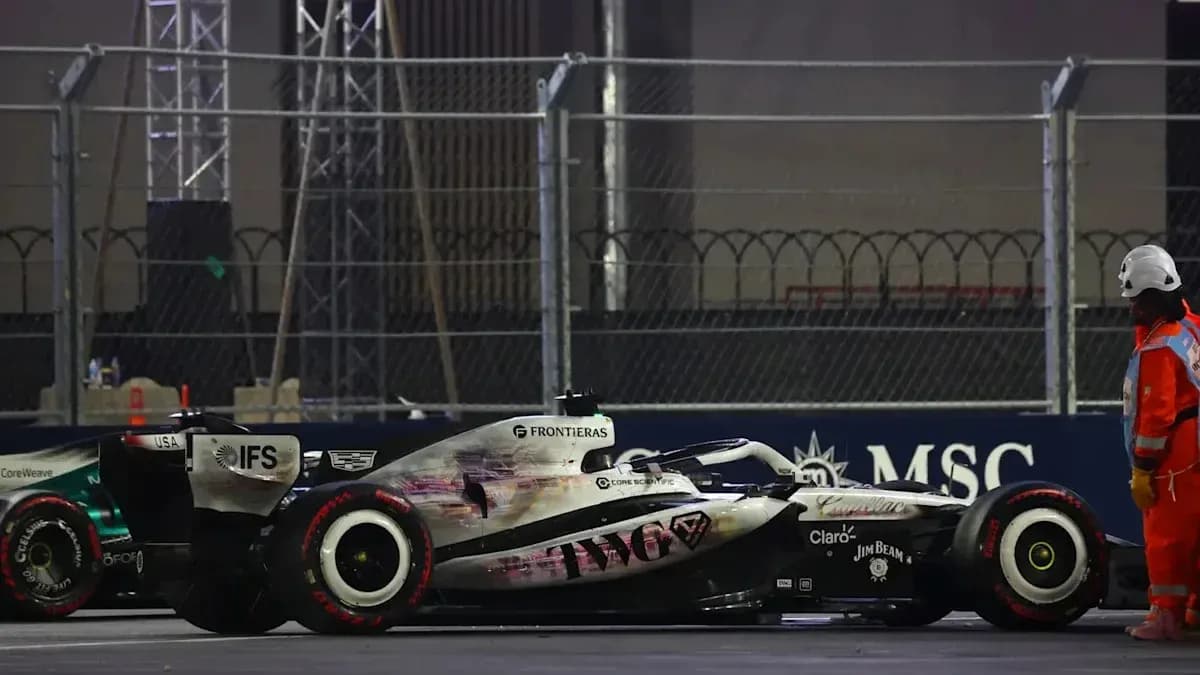
Sergio Perez Faces Grid Penalty After Las Vegas Collision
Sergio Perez left Las Vegas with more than just frustration and a damaged car. He also carries a five-place grid penalty into Qatar, after stewards pinned the blame for his collision with Rafael Camara squarely on the Mexican.
The clash with the Haas F1 driver ended Perez’s race on the spot. His original 10-second time penalty could not be served because of the retirement, so it now converts into a grid drop for the next round. For a driver already fighting to reassert himself, it is a costly mistake in a city that promised spectacle and delivered controversy.
“Overtake mode” and a closing gap
Speaking after the race, Perez walked through the sequence that led to the contact. In his view, the technology and the timing created a trap.
He explained that he exited Turn 12 around a second behind Camara, then hit what he called “overtake mode” – a surge of power that slashed the gap far quicker than the Haas driver anticipated. Camara, Perez said, believed he was safe.
By the time they arrived at Turn 14, Perez had drawn alongside. Camara, taking what Perez described as a “normal line”, turned in. Perez tried to avoid him, but the move came too late. Metal met carbon. Race over.
Perez stressed that from his cockpit, he expected room to be left for a car on the inside, planning to complete the move later in the lap, around Turn 16. Instead, he found himself in a blind spot.
According to Perez, Camara later admitted he had not realised the Cadillac was there, caught out by how quickly the gap had vanished from Turn 12 to Turn 14. By then, the damage – both literal and in the eyes of the stewards – was done.
Stewards unmoved, Perez still relishes the fight
Race control saw it differently. Their verdict was blunt: Perez was wholly at fault. The 10-second penalty, converted into a grid demotion for Qatar, underlines that view.
Perez, though, took some encouragement from the simple fact he had been in the thick of the action before the collision. He pointed to the battles he had enjoyed, the cars he had been ahead of, the feeling of being properly involved again. For a racer, that still matters.
A sarcastic verdict on Las Vegas “racing”
Once out of the race, Perez stayed at Turn 14, watching the rest of the Grand Prix unfold on a laptop. His assessment of the show Las Vegas served up was laced with sarcasm.
He called what he saw “very artificial” – the same word he had used when describing the way “overtake mode” transformed his run at Camara. In a city built on illusion and spectacle, Perez’s night ended with a blunt reminder of how manufactured modern racing can feel when technology and layout combine to create sudden, brutal moments like his.
Now he heads to Qatar with a penalty, a point to prove, and a lingering question: how much of the racing is still in the drivers’ hands when the systems flick on and the gap disappears in the space of two corners?