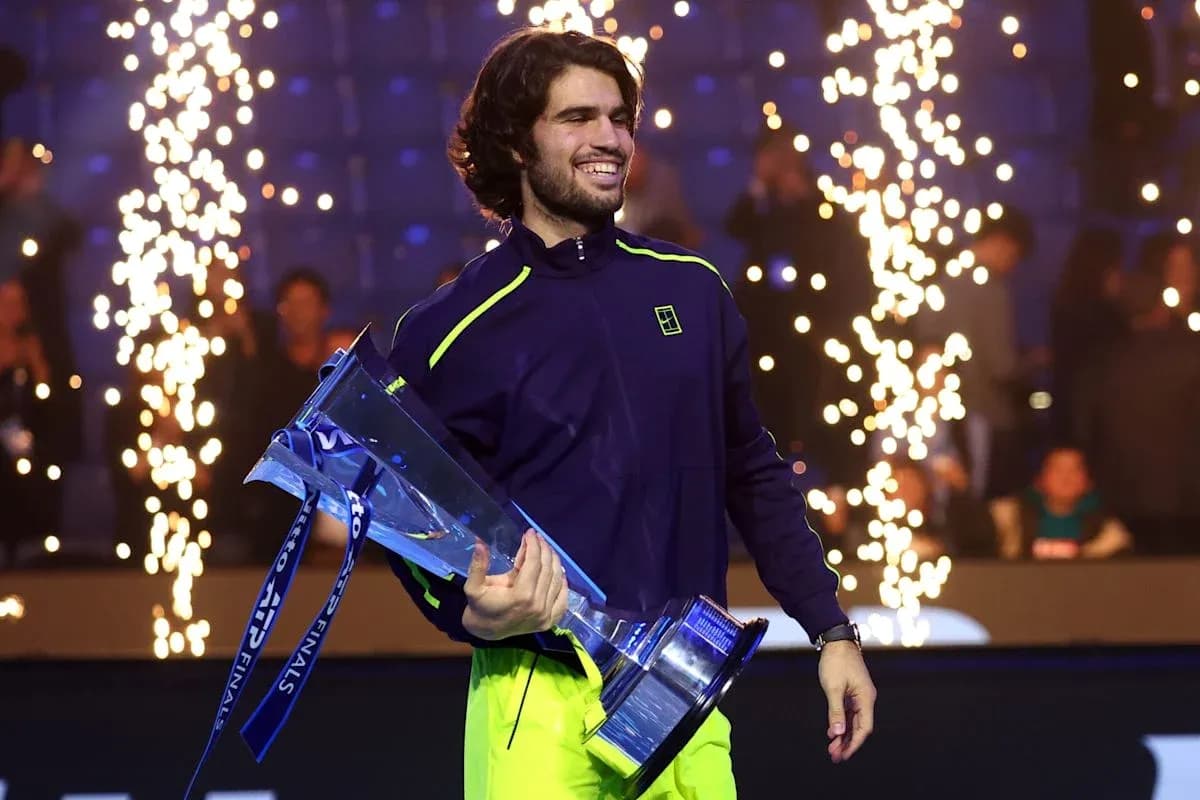
Carlos Alcaraz Claims ATP Finals Title Against Zverev
Carlos Alcaraz closes the argument. At the end of a fractured, injury-hit men’s season, the ATP rankings say Alexander Zverev is world No 1. Turin said something else. On the fastest court of the year, with his leg strapped and his movement compromised, Alcaraz tore through the top seed 6-2, 7-6 (7) to claim his first ATP Finals title and remind everyone who the best player on the planet really is.
This was not the season he imagined. A wrist injury ripped four and a half months out of his year, split the calendar in two and left gaps where his name usually sits in the draws. He missed two majors, skipped two Masters 1000 events – the Canadian Open and Shanghai – and watched others collect points and headlines.
He still hit every major target that matters.
Alcaraz began 2026 by becoming the youngest man ever to complete the career Grand Slam. At 23, he now stands as only the fourth player to win all four majors and the ATP Finals. That is legacy territory, not a hot streak. It is the kind of résumé that usually belongs to men whose best days are already archived, not someone still working out the limits of his own game.
For years, the indoor season was supposed to be his blind spot. Slick, low-bouncing courts that reward serve and first strike, not the full-court chaos he loves to create. That theory is finished. Alcaraz closes his year on a 14-match winning run, with titles in Paris and now Turin, two of the quickest surfaces on tour. He did not just survive these conditions. He bent them to his will.
What makes this week more ominous for the rest is how he did it. A thigh injury against Daniil Medvedev on Wednesday forced him to dial back his trademark explosiveness. The leg was heavily taped. The sprints into the corners, the full-body slides, the acrobatic recoveries – all used more sparingly.
So he adjusted. He played with calculation rather than chaos, conserved energy, picked his moments to accelerate. He learned, in real time, that he does not need to throw himself around at full tilt to beat the best. He can manage his body, play at 90%, and still be untouchable. That, more than the trophy, is the chilling part for everyone else.
Across the net, Zverev arrived in the final with his own story to tell. The German’s serve had been a machine all week. He had not been broken once en route to Sunday, a run that showcased the freakish reliability of his delivery and underlined why he sits atop the rankings. He had also used his time in Paris to question Alcaraz’s right to be anointed as the game’s new standard-bearer.
Within minutes, Alcaraz answered him.
In Zverev’s opening service game, the Spaniard carved out three break points. He read the serve, stepped into returns, refused to be bullied off the baseline. By the second service game, the pattern was set. Alcaraz blocked back enough returns to drag Zverev into rallies, then broke to love. The aura of invincibility on serve was gone before the final had even settled.
From the back of the court, the gap between them was brutal. Forced by his leg to be even more aggressive than usual, Alcaraz played with a blend of power and craft that Zverev could not match. He mixed in low, skidding slices and slower, teasing balls that killed the German’s rhythm and coaxed short replies. Then he detonated. The forehand, already the most feared shot in the sport, ripped through the court. The backhand, often overshadowed, was just as lethal, drilled cross-court and down the line with a clarity that pinned Zverev in place.
The first set vanished 6-2. The top seed had barely landed a punch.
Yet Alcaraz rarely chooses the easy road. From 6-2, 4-2 up in the second, he suddenly loosened his grip. The unforced errors crept in. Zverev, who had been outclassed in the rallies, hung on with solid defence and cleaner serving, forcing the Spaniard to win every point the hard way. The scoreboard tightened. Alcaraz found himself serving at 4-5, 0-30, a few loose swings away from being dragged into a decider.
He escaped, as he so often does, then surged 3-0 ahead in the tie-break. Again, he wobbled. Again, he left the door open. Zverev climbed all the way back to hold three set points at 6-3, finally playing with the authority that had carried him through the week, improvising well against Alcaraz’s drop shots and variety.
This was the moment the match threatened to flip. It is also the moment that separates Alcaraz from almost everyone else.
Under the heaviest pressure, his tennis sharpened. The errors vanished. The decisions became ruthless. He wiped out all three set points, then produced the shot of the night: a perfectly disguised, feathered drop shot that died just over the net to bring up match point. One swing later, he finished the job with a backhand down-the-line winner, struck without a hint of doubt.
Tie-break escaped. Title secured. Statement delivered.
Zverev leaves Turin with his own form of vindication. After all the talk around his status as No 1, he backed it up by beating four top-10 opponents to reach the final and by serving as well as anyone on tour all week. He responded on court, where it matters most.
But there are layers at the top of men’s tennis now, and this week exposed them. In Turin, the gulf between Alcaraz and the rest – even the man officially ranked above him – was stark. The sport spent months without him in full flow. It ends the year with a vivid reminder of what it looks like when he is back, healthy enough, and learning new ways to dominate.
The rankings will say one thing for a while yet. The eye test, and nights like this, say something very different about where this era is really heading.