Alexander Zverev's Breakthrough Season: Two Grand Slams and World No. 1
Alexander Zverev has finally produced the season his talent has been threatening for a decade.
In 2026, the German stepped out of the “nearly man” shadows and into the unforgiving light reserved for serial winners: two Grand Slam titles, year-end world No. 1, and a place in the sport’s most exclusive club. And yet, somehow, he still finds himself having to justify it.
A breakthrough years in the making
Roland Garros was the great unblocking. In a men’s field stripped of its usual certainties, Zverev seized the moment on the Paris clay, navigating a wide-open draw to lift his first major. The stigma of near-misses, of semi-final exits and that haunting US Open collapse in 2020, finally loosened its grip.
The release was immediate. By the time the tour hit New York, Zverev looked like a player who understood that windows in tennis do not stay open for long. Six years after blowing a two-set lead in the US Open final against Dominic Thiem, he came back to the same stage and this time finished the job, collecting his second Slam of the year and rewriting one of the most painful chapters of his career.
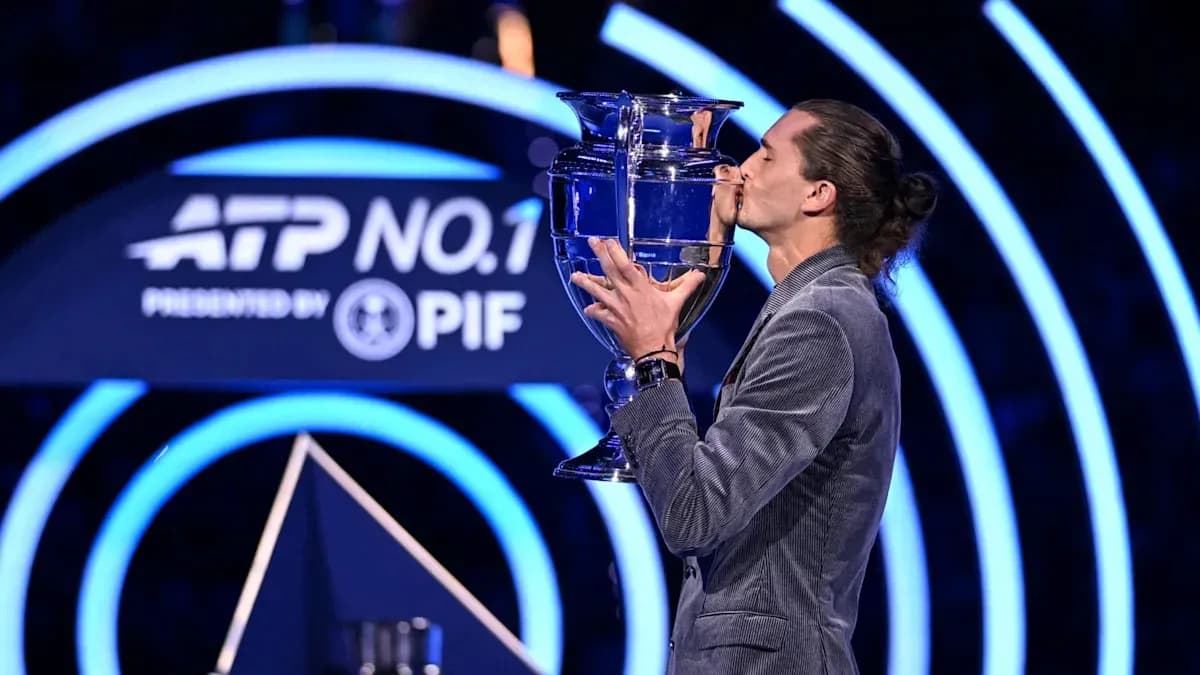
Those two trophies, combined with relentless week-to-week consistency, pushed him to world No. 1 for the first time. On paper, it is the season every player dreams of. On social media and in certain corners of the fan base, it has been treated as a debate topic.
“The elite of the elite”
Zverev himself has felt the need to address the noise. “I feel like I'm the only world number one in tennis history who has to explain why it's OK for me to be world number one,” he said recently. That frustration has resonated with at least one former major champion.
Speaking to Les Grandes Gueules du Sport, 2013 Wimbledon winner Marion Bartoli did not hide her irritation at the criticism swirling around the German’s résumé.
“This is a debate that exasperates me, because, once again, being world number one, you have to realize what that represents,” she said. “He's only the 30th world number one in the history of the game, meaning you're in the top 0.01%, the elite of the elite.”
Bartoli pushed back hard against the idea that Zverev’s rise should be footnoted by the misfortunes of others or the quirks of a single season.
“In 30 or 40 years, there won't be a little asterisk next to Zverev saying: he was world number one, but Sinner had a heat stroke at Roland Garros, or Alcaraz was at the US Open, but he lost to Shelton because he was coming back from a wrist injury,” she argued. “You can replay the tournaments endlessly, but he truly earned his Grand Slam titles.”
The numbers back her up. Zverev has posted a 92.6% win rate in Grand Slam events this year, a staggering level of efficiency across four majors, surfaces, and continents. That kind of dominance over 10 gruelling months is not an accident.
“It's part of daily training to be able to perform at the highest level for 10 consecutive months,” Bartoli added. “This is extremely difficult given the current physical demands on the men's circuit.”
The strange stat on his record
Yet the asterisk brigade has not disappeared. Their main ammunition: Zverev’s record against the very best in 2026 and the number of trophies on his shelf.
Despite ending the year as No. 1, he has struggled against Jannik Sinner and Carlos Alcaraz, the two men widely tipped to define the era. His lack of top-10 wins this season has fuelled the argument that the rankings have rewarded consistency more than supremacy.
On top of that, Zverev now owns an unwanted slice of history. He has set a new record for the fewest titles won by a year-end world No. 1 in a single season. The previous low mark was four, shared by Rafael Nadal in 2019, Novak Djokovic in 2018, Roger Federer in 2009 and Pete Sampras in 1998. Zverev has dipped beneath that line.
It is a curious contrast: a player with two majors and the top ranking, yet fewer total trophies than any year-end No. 1 before him. Fuel for detractors, perhaps. But also a reminder of how brutal and evenly spread the men’s tour has become.
No asterisks on the scoreboard
Strip away the narratives, and the facts are blunt. Two Slams. World No. 1. A Grand Slam win rate north of 90% across a full season. Those numbers do not come with disclaimers.
History will not annotate the draw sheets with notes on heat strokes, wrist injuries, or who peaked when. It will simply list Alexander Zverev as a Roland Garros champion, a US Open champion, and the 30th man ever to finish a season at the top of the rankings.
The real question now is not whether he deserves that status. It is how long he can hold it in an era where Sinner and Alcaraz are coming at him, week after week, with no intention of letting this become his decade.